Sunday, April 8, 2012

Opening Day Of Trout Approaches

By Bob Frye, TRIBUNE-REVIEW
Sunday, April 8, 2012

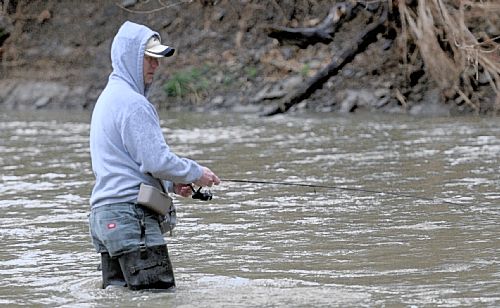
Opening day of trout season Saturday will find some anglers standing in the same place they were last year, and the year before that and the year before that.
That`s part of the tradition.
But if you`re undecided about whether to fish, or where to go or what to do when you get there, here are some things to consider:
Think big early
Are big fish important to you?
The Pennsylvania Fish and Boat Commission stocks 8,500 trophy golden trout and 20,000 brook, brown and rainbow trout brooders annually. They average 16 to 20 inches long and sometimes go as big as 24. Notably, 70 percent of them are stocked for opening day.
"So, yes, the first week is your best time to catch something that`s bigger than average," said Tom Greene, coldwater unit leader for the Fish and Boat Commission.
Stocking dates
When was the waterway you`re looking at last stocked?
Typically, lakes and streams lose about 1 percent of their trout — to natural causes, predation, movement or poaching — each day after being stocked, said Rick Lorson, the commission`s fisheries manager in Somerset. That means a waterway stocked one week before the opener will have more fish than one stocked with a similar number of trout three weeks earlier, Lorson said.
Types of trout
What kind of trout do you want to catch?
The commission often puts more than one kind of trout in the same waterway. But, as a general rule, lakes get mostly rainbows, while streams in the Laurel Highlands get a lot of brooks and browns and those in Allegheny County and points west get browns and rainbows.
Of the three, brook trout are the easiest to catch, browns the hardest, Lorson said. That makes brookie streams good bets early in the season, brownie streams good later.
Solitude or socialization
Is your priority solitude or camaraderie?
If it`s the former, look at the stocking list and pick a short stream in a rural area that gets just one load of fish. The commission stocks trout on a per-acre basis, with more fish put more often in waters near population centers. If a stream is getting few fish, that means it also sees relatively few anglers, Lorson said.
But if you prefer company — and often more parking, easier access, facilities like restrooms and even special services — consider lakes. At Keystone State Park, for example, its Friends group, which raises money for projects like developing fish habitat, will staff a concession stand at the boat rental Saturday. Between 6 a.m. and 5 p.m., anglers can get a cup of coffee, a sandwich or snacks for the kids.
"It`s a lot of fun for us. And I think the fishermen really appreciate it, too," said Pam McQuistan, the park`s environmental educator.
Move and wait
Most stocked trout don`t venture more than a few hundred yards from where they were released, Lorson said. So if you`re not catching fish and someone up or downstream is, move in when they leave, he said. Just don`t give up.
"The fish are going to be there," he said. "Sometimes it just takes patience."

Lack Of Volunteers May Doom Cooperative Nursery


By Bob Frye, TRIBUNE-REVIEW
Sunday, April 8, 2012

Finally, someone understood.
Art Grguric was reading a story in the Tribune-Review several weeks ago, one in which Andy Shiels, deputy director of operations for the Pennsylvania Fish and Boat Commission, was quoted as telling state lawmakers that some cooperative trout nurseries are in danger of disappearing because they`re having trouble finding volunteers to carry on the work of raising and stocking fish.
That`s the Blackleggs Creek co-op`s problem exactly, Grguric said.
"That story really hit the nail on the head," Grguric said. "Raising money is not the issue. We can always raise money. Raising members is not even the issue. The problem is getting members who want to do some work."
The Indiana County nursery has been stocking trout in Blacklegs Creek for 26 years. A decade ago, more than a dozen people split the work of feeding fish and maintaining the nursery year-round.
Now, that`s fallen to Grguric and just a few other volunteers, one of whom is only available on weekends.
That`s too much, Grguric said. And the result is that, if more volunteers aren`t found soon, the co-op is going to go out of business after this spring, he said.
That would mean a drastic reduction in fishing opportunities. The Fish and Boat Commission stocks Blacklegs Creek twice each spring, releasing about 1,500 trout total. The co-op nursery, by comparison, stocks the stream with about 2,000 fish per week for seven weeks.
All of those fish would be lost just as the Blacklegs Creek watershed – once so polluted with acid mine drainage that it held no aquatic life – is nearly completely restored.
"There`s been about $2 million in federal, state and local money invested in improving the watershed over the years. That`s all led to really incredible improvements," said volunteer Anne Daymut, who also works with the Western Pennsylvania Coalition for Abandoned Mine Reclamation.
"It would be a real shame if there aren`t trout in there anymore."
The nursery is asking potential volunteers to call Grguric at 724-972-8675 or visit its Facebook page. On Saturday, opening day of trout season, Grguric, Daymut and others will put fliers asking for help on the windshields of vehicles parked along the creek for opening day of trout season, too.
Grguric hopes that helps because, if not, there`s no choice left but to let the nursery die.
"It`s something good, but it`s going to go by the wayside if we can`t find help," Grguric said. "Guys don`t realize what they`re going to lose."


Sunday, April 1, 2012

New Bill Attacks Fish Poachers

About the writer
Bob Frye is the Tribune-Review outdoors editor.
He can be reached at 724-838-5148 or via e-mail.

For most anglers, steelhead fishing means an opportunity to spend time with friends, enjoy some often great weather and catch the kind of huge fish that just aren't available most places.

For others, it's all about the money.
The sad truth is there's a class of big-time poachers who collect fish in the largest quantities possible, by fair means or foul, for commercial sale. Pennsylvania Fish and Boat Commission officers tell tales of people taking up to 70 steelhead at a time, using not only rods and reels but casting nets, giant snag hooks and even spears.

"There are a lot of things going on beyond people having just a few fish over the limit. We're talking dozens of fish," said Bob Nestor, supervisor in the commission's northwest region office.

What's worst of all is that, right now, the penalties for stealing from honest sportsmen in that way are insufficient deterrents. "In each case, all that the Fish and Boat Commission can currently do is to cite them for a summary offense and fine them $50 for each offense. Perpetrators willingly pay this fine as a cost of doing business, literally taking out rolls of $50 bills to pay the fine," said state Rep. Michael Peifer, a Monroe County Republican.
But that could change. Peifer on Friday introduced legislation, House Bill 2293, that would deal with serious poaching violations. It involves bigger fines, lost fishing privileges and even possible jail time.

"The bill was structured to account for differences between the angler who maybe made a lapse in judgment and kept one fish too many and the serial, commercial poacher who is taking fish for profit," said Greg Raffensperger, executive director of the House of Representatives game and fisheries committee.

There's more of that serious poaching going on than some people realize, said Jeff Bridi, an assistant director of the commission's bureau of law enforcement. Steelhead are one species poachers target; striped bass that run up the Delaware River -- and often weigh 40 pounds or more -- are another.

"Our officers have observed people using cell phones and taxi cabs to ferry fish out," Bridi said. "Someone will catch two or three fish, then, if they think no one's watching, call a cab or a partner in a car nearby to get them out and to a restaurant or market."

Peifer's bill is the third and final piece of a larger package, said Tim Schaeffer, director of the commission's policy and planning office. First, lawmakers passed a law enrolling Pennsylvania in the Interstate Wildlife Violator Compact, which suspends in all member states the hunting or fishing license privileges of poachers convicted in any member state. Second, lawmakers increased the fines and penalties for poaching wildlife like deer, bears and other species.

"This bill would take care of things on the fish side and sort of complete the circle," Schaeffer said. The bill has 60 cosponsors, a high number that augers well for its chances of passing before the current legislative sessions ends, likely in September, Raffensperger said. That means the stiffer penalties could be in place for this fall's steelhead run, which would be a good thing, Nestor said.

"Some of these people, they'll pay their fines the next week, then they're right back out fishing. We want to address that," Nestor said.
 Steelhead taken illegally
Courtesy Pennsylvania Fish and Boat Commission
The specifics
House Bill 2293 would, among other things:

» Make it a misdemeanor of the second degree to take, catch, kill, or possess three or more times the daily limit of fish or fish having a replacement value above a defined level. The Fish and Boat Code defines fish as including all fish, amphibians, reptiles and aquatic organisms, so this would capture the illegal reptile trade as well.

» Increase the duration for which the Fish and Boat Commission may revoke an individual's fishing and boating privileges from two to five years, which is consistent with the rules regarding hunting license revocations.

» Increase summary offense fines for the first time in more than a decade.

» Increase the discretionary penalty for each fish taken, caught, killed, possessed, or sold in violation of the Fish and Boat Code for the first time since 1980.

» Provide for an optional additional penalty for those individuals who use illegal devices to take fish.

Consider Advanced Bait-fishing Techniques for Trout

By John Hayes / Pittsburgh Post-Gazette

Keith Gill of Trafford wades into Pine Creek in 2011.
Photo Pam Panchak/Post-Gazette
Having multiple bait-fishing techniques at your disposal can make all the difference.Depending on how you fish, trout can seem persnickety and selective or opportunistic and voracious. Both perceptions are accurate.

For a fly fisherman standing hip deep in Deer Creek during a spectacular hatch of No. 22 Blue-winged Olives and fumbling through a fly box of Black Stoneflies and Wooly Buggers, trout can seem particular about their diet. When he comes back with No. 16 Olives and still can't get a rise, trout can seem frustratingly, irritatingly sensitive to food size -- almost like the snub is personal.

Trout fishing seemed a cinch in recent weeks for anglers taking advantage of the Early Season Trout-Stocked Waters Program at Keystone and Mammoth lakes. Dozens of anglers limited out with ease on paste baits, red worms, butter worms, salmon eggs -- just about anything they threw into the water.

In most cases, when the statewide trout season opens at 8 a.m. April 14, the most successful anglers will be those who adapt their equipment and techniques to changing conditions.

That bobber-and-crawler rig that worked so well on the lake last summer will catch fish until an atmospheric cold front pushes the trout too deep to see the bait. Hooking minnows under the spine is fine until you cast into a creek and turn your bait into a propeller blade. And those 1/0 treble hooks and 1-ounce pyramid sinkers you bought at Walmart are absolutely perfect ... for your Virginia Beach surf fishing vacation.

"The biggest mistake I see people making is probably using a too big hook and too heavy weight," said Karen Gainey, a state-certified fishing instructor who teaches at the Community College of Allegheny County and hosts the Venture Outdoors Downtown TriAnglers outings Wednesdays in the summer on Pittsburgh's North Shore.

"They're using the wrong equipment for conditions," said Gainey. "Heavy line in low, clear water, or an ultralight rod rigged for big fish. God help them if they every catch one -- the rod won't handle it."

Gainey likes golden hooks. "The fish don't see them as easily as they do bronze hooks," she said. On moving water, she baits a No. 6 hook with half a crawler. Instead of balling the bait, a common rig, she inserts the hook once at the head and lets it hang out. "I want it to look as natural as possible," she said.

Gainey crimps on three BB-size split shot about 18 inches above the hook, spreading the shot about 2 inches apart, "so they don't drop like a rock." Cast upstream into the current and reel in the slack.

"It works well in the least bit of a hole or waterfall, and at North Park Lake where the bottom drops off," she said. When conditions call for baits to be suspended at a particular depth, she turns to live minnows. "For trout, I like small minnows, 1 1/2 inches to 2 1/2 inches," she said. "Hook them under the chin, straight up under the eyes so they'll stay alive and swim around, with no weight between the bobber and the hook."

If a frightened minnow runs to the surface, said Gainey, the action excites the predator into chasing it. "At Canonsburg Lake and North Park, I like about 3 feet between the hook and bobber. A 1 1/4-inch round bobber gives you enough weight to cast."

It's hard to find 2-inch crayfish at a bait shop, but Gainey said there's no better tidbit for trout. Pinch off the claws so they don't clamp onto the bottom and hook upward through the tail shell. In moving water, weight it, toss upstream and work it through the current with a tight line. In a pool, she said, swim it across the face of the downstream riffle.
"Little fish won't take the crayfish," she said. "We're talking serious fish."

Mike Milvet, owner of Cross Creek Bait Shop near Avella, said too often anglers get comfortable with a single technique and use it in all conditions. When the fish change what they're doing, he said, tackle and techniques should change.

"In a stream with a steady current, I like to put on a bobber and cast upstream with a Mini Foo [jig] or a minnow," he said. "If I'm using a minnow, once I find the depth of the stream I set the bobber to keep the minnow off the bottom, and put on a B or BB-size split shot to keep the minnow down."

In cloudy water, Milvet goes to a classic muddy water rig. "My dad's old favorite was a Velveeta cheese ball," he said. "A PowerBait or any of the more scented baits will work, too, mostly with rainbows. When it's muddy, fish it deep."

Lake-bound browns and rainbows are attracted to paste baits, which generally float. Milvet uses their buoyancy to his advantage, fishing deep with a smorgasbord of baits. "If I'm fishing [an impoundment] such as Canonsburg Dam, I'll slide on a barrel sinker [one-eighth or three-sixteenths ounce] and tie on two treble hooks [No. 16-14] -- one on the end, one above," he said. "I put a BB shot about 12 inches above the upper hook. The line runs through the slip sinker so the fish feels no weight, just the split shot. I like to use PowerBait on the end, then put a combo of meal worms and a couple of maggots on the other hook. The PowerBait will float and pull the meal worms and maggots up, so they're not laying on the mud bottom."

When the trout streams near Seven Springs get a little murky, John Dressler, co-owner of Red's Bait Shop in Acme, fishes salted minnows with a spinning rod. Unlike the fly rod salted minnow technique, in which a needle is used to thread the minnow onto a double hook, Dressler's spinning method spears the bait behind the head with a No. 8 hook.
"I put split shot at least a foot away from the hook," he said. "I usually cast out and let the current work it, or if I'm in a nice hole, I'll jig it, let it settle, jig it, let it settle, then reel it in."
On Donegal and Laurel Hill lakes, Dressler likes wax worms under a wooden egg bobber.

"Set the depth at 5 or 6 feet below the bobber," he said. "I use the egg bobber for weight for casting, and put two eyelets on each end of the wooden bobber. I usually tie the line to a snap swivel, and snap it onto the [top of the] bobber. I tie 5 or 6 feet of line onto another snap swivel and snap that to the bottom of the bobber, and run the line down to a split shot and the hook. If you want to change the depth, just unsnap the line and snap another on."
On the hook, he hangs three wax worms or four to five maggots.
"I've been doing that for years," he said.

Sunday, March 25, 2012

Conservation One Part of Statewide Trout in the Classroom Program

By John Hayes / Pittsburgh Post-Gazette
No one is born with an innate understanding of nature and how to relate to it in a civilized world. It's acquired knowledge.
A student at McKnight Elementary School releases a brook trout fingerling
 at North Park Lake in 2011 as part of the Trout in the Classroom program.
Since 2006, about 63,000 Pennsylvania students have participated statewide.
A growing number of conservationists say that's bad news for a generation of Americans growing up with few outdoors mentors and little connection to nature. Conservationists including best-selling author Richard Louv warn that "nature-deficit disorder" has dangerous implications for a growing body of voters with little boots-on-the-ground knowledge of how nature works and a skewed appreciation of its value.
But in a climate of bureaucratic penny pinching where serious cuts to education budgets are routine, one statewide program brings practical, hands-on cold-water conservation into the classrooms.
With roots embedded at the Pennsylvania Fish and Boat Commission, Department of Education and state council of Trout Unlimited, and with tendrils reaching into nearly 200 Pennsylvania schools, Trout in the Classroom is exactly what its name suggests: kids actually raise brook trout from eggs to fingerlings in classroom aquariums and release them into nearby waterways. None of the program's marginal costs are paid through local school taxes, and the educational value stretches beyond conservation to include mathematics, engineering, sciences and English and communications skills.
"Plus, the kids love it," said Josh Cramer, a teacher at South Park Middle School. "It's become this whole sixth grade thing. Every teacher teaches a part of it."
Eight years ago, Cramer and South Park science teacher John Dieterle initiated one of several pilots testing the program for Fish and Boat. Trout in the Classroom was officially launched in 11 classes in 2006.
"Today the project is in 187 classrooms across Pennsylvania, and has reached about 63,000 students statewide," said Spring Younkin, regional outreach and education coordinator for the Fish and Boat Commission.
In Southwest Pennsylvania, Trout in the Classroom is in 36 schools including South Park Middle School, McKnight Elementary School in McCandless, Winchester-Thurston School in Shadyside and The Academy Charter School in Hays. The program is active throughout the United States, Canada and United Kingdom.
Participation is initiated by individual teachers with the support of their schools. Education grants from Fish and Boat, Trout Unlimited, the Department of Education and local nonprofit partners pay for fertilized brook trout eggs cultured at Fish and Boat's Benner Spring Hatchery in Bellefonte. The grants are also used to buy the aquariums, aerators, fish food and other supplies used in the classrooms. Trout Unlimited and Fish and Boat provide the personnel, technical assistance and educational workshops necessary to manage the program.
On a daily basis, students care for the eggs, watch them hatch and help them grow before releasing the fingerlings into the wild. Along the way, they learn about the biology of Pennsylvania's state fish and the importance of cold-water conservation, build ties with the community and, their teachers hope, become lifelong stakeholders in the natural environment.
Each Trout in the Classroom experience is unique because each school puts its own spin on how it supplements existing curricula.
At South Park, a certified engineering middle school, sixth and eighth graders focus primarily on the scientific, technological, engineering and mathematical aspects of raising the fish. Family Tyes, a nonprofit group that provides youth mentoring through fly fishing, is the community partner.
"The big thing for us," said Cramer, "is having kids understand that subjects relate to one another -- putting it all together in the classroom."
McKnight Elementary School takes Trout in the Classroom to the second-grade level.
"In elementary school the kiddos learn the life cycle of frogs and butterflies and chicks," said teacher, fly fisherman and Penn's Woods West Trout Unlimited newsletter editor Christian Shane. "The trout tie in really nicely for the kids."
At The Academy, an alternative charter school for court-adjudicated students in grades 8 through 12, most from urban public schools, the focus is on introducing city kids to nature.
"They really focus on learning about the ecosystem of the local watershed," said school spokesman Dick Roberts, "and even taking the field trip to release the trout in Montour Run is an experience they never would have had in their home schools."
Fish and Boat stresses the linkages between stewardship of aquatic resources and recreational participation, which in turn, the agency believes, leads to more active stewardship.
"People are used to seeing adult trout," said Younkin, "but they don't always understand how delicate they are when they're young and how human impacts on the creeks affect them, and why we have to stock trout in some areas."
In November, about 60,000 brook trout eggs were shipped to participating schools across the state -- each school gets 250 to 300 eggs. Survival in captivity is generally better than in the wild, and classes typically release 50 to 100 fingerlings. If tank mortality is high, Fish and Boat sends a batch of ready-to-release fingerlings. Students tend to bond with their "fishy friends" -- some of the trout are given names -- but Younkin said the fingerlings aren't expected to survive to adulthood in the wild.
"It's not a restoration program," she said. "It's there to educate kids about the life cycle and cold-water conservation. Whether they release one fish or 100, they've still had a successful program."

State Opens First Trout Trail

By Bob Frye, TRIBUNE-REVIEW
Sunday, March 25, 2012

Pennsylvania has long had hiking trails, bike trails and ATV trails. More recently, it's even had water trails. Now, it's got its first trout trail.
And it's right here in southwestern Pennsylvania.
Representatives of local tourism organizations, Trout Unlimited, the state Department of Conservation and Natural Resources and others have given birth to the Laurel Highlands Trout Trail, a "pathway" that fly fishermen can follow to enjoy good angling on public lands from Ligonier to Ohiopyle.
George Daniel
Champion fly fisherman George Daniel

The idea for it grew out of an episode on the Outdoor Channel, said Monty Murty of Ligonier, president Trout Unlimited's Forbes Trail chapter and Pennsylvania's representative on its national council. It featured Spruce Pine, N.C.
"It was all about fly fishing in this little town, and as I watched it, I realized it was so much like Ligonier. It had a downtown trout stream, sort of upscale tourist stops, all that," Murty said.
"And I realized it was being featured just primarily because of a promotional thing, a strategy."
He thought his hometown could be marketed in the same way. As he started talking to others, though, the idea grew from focusing on one town to the greater Laurel Highlands "corridor."
The result is the regional trail, which highlights opportunities to fish waters ranging from stocked Loyalhanna Creek to wild trout streams like Camp Run and Quebec Run to the trophy fishery of the middle Youghiogheny River.
Fly fishermen are being targeted in particular -- and are a large reason so many non-fishing-specific businesses are involved in the trail effort -- because of the demographic they represent, Murty said.
According to research done by the Recreational Fishing and Boating Foundation and the Outdoor Foundation, the most common income bracket for all freshwater anglers is $25,000 and $49,999 per year. The typical fly angler, by comparison, earns $100,000 annually.
A study done by the U.S. Fish and Wildlife Service, meanwhile, found that trout anglers tend to be more educated and to spend more on things like transportation, guide services and equipment annually than other freshwater fishermen.
"I kind of repeat the old joke that trout fishing in Pennsylvania is like attending church: many attend but few understand," Murty said. "Once people start to see the demographics of fly fishing, they start to think wow, these are the people we should be marketing to."
The trout trail is not just about fishing, though.
Olga Herbert, executive director of the Lincoln Highway Heritage Corridor, a tourism group, said it has three goals: to get area residents to understand the importance of protecting the resources in their own back yard; to promote tourism; and to spark economic development. It will best succeed at all of those if trail organizers can reach more than just the fishermen in families, she said.
"We already have a lot of fellas who come here to fish. We're trying to get moms and children to come in, to stay overnight and to see what the area is all about," Herbert said.
That's why places like Fort Ligonier, Compass Inn Museum and the Ligonier Theater are offering promotions and hosting events in connection with the trail, she said.
"We're hoping that this is going to be well received," she said. "This is something new. I'm pretty excited."
"We're going to show the value of cold clean water, that it pays, it doesn't cost," Murty agreed.

Friday, March 23, 2012

Game Commission Urges Support For Wildlife Housing Issues

            HARRISBURG – As development continues to consume wildlife habitats, the Pennsylvania Game Commission’s Howard Nursery has devised a way for wildlife enthusiasts to help support wildlife housing needs without having to apply for a second mortgage. The nursery is selling a variety of wildlife nesting structures for several species of birds – from bluebirds to flickers and ducks to owls – as well as housing boxes for bats and squirrels. 
“According to Pennsylvania’s Wildlife Action Plan, development consumes more than 300 acres of Pennsylvania’s landscape per day,” said Carl G. Roe, Pennsylvania Game Commission executive director.  “Although we can’t keep pace with losses caused by urban and suburban sprawl, the Game Commission is working hard to preserve and improve habitat on its more than 1.4 million acres of State Game Lands and other public and private lands.
“For years, our Howard Nursery has been constructing a number of different wildlife nesting structures for placement on State Game Lands and to private landowners enrolled in the agency’s Hunter Access Program. To enable private landowners to lend a hand to wildlife, we also are offering for sale a variety of nesting boxes, beyond the popular bluebird boxes.”
Homeowners – the human kind, that is – can view the entire selection of nesting structures for sale on the Game Commission’s website (www.pgc.state.pa.us) by clicking on “General Store” in drop-down menu bar under the homepage banner, clicking on “Howard Nursery Products” and then choosing “Wildlife Homes Order Form.”  The two-page brochure and order form lists the nesting structures by habitat type, to guide landowners in determining which nesting structure is best suited for their property. 
Available nesting structures - listed by habitat types and approximate sizes (in inches) and prices - are as follows:
Open Land or Woodland Margins – American kestrel box, 24x10x12, $20; gray and fox squirrel box, 22x12x13, $31; bluebird, chickadee or wren box (completed) or kit (unassembled), 14x6x8, $9; northern flicker box, 32x8x12, $40; bat box, 36x25x10, $95; or winter roosting box (can be used by chickadees, wrens, nuthatches, titmice, woodpeckers or bluebirds), 30x10x12, $30.
Hardwood Forests – barred owl box, 33x18x16, $50; or flying squirrel box, 9x9x13, $25.
Farmlands or Open Lands – barn owl box, 17x41x12, $58.
Wetlands and Associated Uplands – wood duck box, 31x12x12, $31; or mallard duck box, 24x13x13, $27.
Prices listed do not include shipping/handling costs, which range from $9 to $26 per unit, plus applicable state sales taxes.  All boxes come assembled and with instructions on where and how to place. 
Once an order is received, a representative from the Game Commission’s Howard Nursery will contact the customer to confirm the order and discuss scheduled shipping dates.  Completed orders can be mailed (P.O. Boxes are not acceptable for delivery), or arrangements can be made for customers to pick up their orders at Howard Nursery. 

Sunday, March 18, 2012

Instructors Offer Advice on Tying Trout Patterns That Catch Fish

By John Hayes, Pittsburgh Post-Gazette
With easy access to the Laurel Highlands, Central Pennsylvania and Steelhead Alley, it's no surprise that the Pittsburgh area has a lot of outstanding fly tiers.
A TV monitor provides a live, close-up, wrap-by-wrap  perspective
on the creation of a Pheasant Tail Soft Hackle variation, as fly tying instructor
Bruce Cox demonstrates at a recent meeting of Penn's Woods
West Trout Unlimited. -John Hayes/Post-Gazette.
The opening of trout season is just three weekends out, and most of the regional fly tying courses that started in January and February are wrapping up. Fly anglers are wrapping like mad.
At weeks-long courses and one-time classes, demonstrations and events, tying aces offered tips for beginners and experienced fly tiers.
Bruce Cox, a veteran instructor for International Angler in Robinson and the Tri-County Trout Club of Lower Burrell, said many tiers are limited by making the same subtle mistakes.
"Pay attention to the details," said Cox, of Springdale, during a tying demo last week at Penn's Woods West Trout Unlimited in Brentwood. "What I see is people not paying attention to proportions. In most cases you're going to tie clockwise. Divide the shank by thirds allotting one-third for the thorax, two-thirds for the abdomen."
Often, he said, experienced tiers become accomplished at a particular technique, but they try to use it in every situation.
"Be flexible. Once you master one technique, don't apply it to every kind of fly," said Cox.
"Everybody's taught to whip finish the head of a fly. But when you're tying parachutes, if you use a whip finish tool you might tie over some of the parachute fibers. Use the half-inch tool, put on a double half hitch and a drop of head cement and it will never come off. If that's good enough for George Harvey [the Western Pennsylvania fly fishing legend who founded Penn State's vaunted fly fishing course], it's good enough for me."
On March 26, at a 7 p.m. meeting of the Upper St. Clair Fly Fishing Club (www.uscflyfishing.org), Cox will demonstrate tying midges and other small patterns.
Bill Nagle of Bridgeville, fly fishing expert for L.L. Bean at Ross Park Mall, says he advises beginners to avoid over-tying.
"My experience is that the novice tier often doesn't tie sparse enough," he said. "They use too much dubbing or too much hackle or too many thread wraps. They tend to tie them too robust."
In the wild, most flies are extremely thin -- anatomically efficient -- and their silhouettes, as seen from below by trout, are very small. Nagle said bulky fly patterns may seem unnatural.
"You don't see insects that are overweight," he said. "You put two or three layers of wrap on the hook and you may already be exceeding the size of the natural."
Efficiency in tying is important, too. Nagle says a good fly shouldn't take more than a few minutes to tie.
"You can spend hours tying a fly that looks beautiful or five minutes on a very similar-looking fly that will catch fish," he said. "When I'm tying for myself, if I can't tie a fly in two or three minutes, it's not worth my time -- I'm going to lose so many, I need a large supply."

Friday, March 16, 2012

PA Fish Commission Partners with Pirates Baseball

HARRISBURG, Pa. – The Pittsburgh Pirates and the Pennsylvania Fish and Boat Commission (PFBC) are teaming up this year to offer an exclusive discount to Pirates fans with fishing licenses.
“During the baseball season, 2012 fishing license holders are eligible to purchase discounted tickets and receive a free custom, limited-edition Pirates ball cap with each PNC Park game ticket,” said Ted Walke, chief of the PFBC’s division of outreach. 

“The offer is good for outfield box tickets on any day of baseball, with the exception of opening day and Saturday games.” 
The Pirates will open their season at PNC Park on April 5. This special offer will begin on Sunday, April 8, when the Pirates take on the Philadelphia Phillies in a 1:35 p.m. game.

Each fan who takes advantage of the offer will receive an outfield box ticket and a limited-edition ball cap for only $21, a $3 discount. Each ticket is good for one high-quality, blue camouflage pattern cap made especially for the Fish and Boat Commission.

The promotional offer is good for advance ticket purchases only. Visit the Pirates web site atwww.pirates.com for a seating chart. Fans can complete an order form on the PFBC website and mail it to the Pirates office or fax it to 412.325.4410. Phone orders cannot be accepted.  The online form (with more details) can be found at:http://fishandboat.com/promo/2012events/pirates-mag-form.pdf.