Monday, November 20, 2017

WILL PENNSYLVANIA’S BUCK HARVEST INCREASE A THIRD STRAIGHT YEAR?

HARRISBURG, PA - Pennsylvania’s coming firearms deer season packs promise for hundreds of thousands of hunters as they await its opener the Monday after Thanksgiving.
Unseasonably warm weather and an abundance of fall mast made it more challenging to pattern deer movements throughout the statewide six-week archery season, which concluded Nov. 11. Now “rifle season” offers the next opportunity to hunt deer in Penn’s Woods.
Most of Pennsylvania’s deer harvest comes from hunters participating in the firearms season. It has been the Commonwealth’s principal tool for managing deer for more than a century. It is the season that draws the largest crowd. The season for which some rural schools still close their doors on the opener to allow their students – and teachers – to hunt.
The firearms season opener is the day every deer hunter wants to be afield. It’s almost always the most exciting day of the season and therefore usually offers the greatest opportunity. About a quarter of the season’s buck harvest occurs on the opener.
But this firearms season – not just its opening day – has the potential to be something special.
“Agency deer biologists believe there’s a chance we’ll see the state’s buck harvest increase for the third consecutive year,” explained Pennsylvania Game Commission Executive Director Bryan Burhans. “It’s an exciting possibility that banks on last year’s massive acorn crop and a mild winter paving the way for big bucks to get bigger and for more young bucks grow into legal racks.
“There’s no doubt something special is happening,” Burhans continued. “For the past few months, hunters have been sending us trail-cam photos of amazing bucks, maybe even new state records. Our field officers also are seeing plenty of bucks from farm country to the big woods. Some are real wall-hangers out there.”
Larger-racked – and older – bucks are making up more of the deer harvest with each passing year. Last year, 149,460 bucks were taken by hunters, making it the second-largest buck harvest in Pennsylvania since antler restrictions were started in 2002.
In 2016, 56 percent of the antlered buck harvest was made up of bucks 2½ years old or older, said Chris Rosenberry, who supervises the Game Commission’s Deer and Elk Section. The rest were 1½ years old.
“Older, bigger-racked bucks are more of the norm in the forests of Pennsylvania than they have been for at least a couple decades,” Rosenberry said. “There’s no doubt antler restrictions paved the way. It was a big step forward 15 years ago, and today we’re seeing the results for protecting young bucks.”
Every year, Pennsylvania hunters are taking once-in-a-lifetime bucks. Some are “book bucks,” antlered deer that make the Pennsylvania Big Game Records book or Boone & Crockett Club rankings. Others simply win neighborhood bragging rights.
But bucks don’t have to be big to be special.
“A buck that eludes hunters for years and years on a mountain or in a farming valley is just as special as the big boys that make the books,” emphasized Burhans. “The elusive ones might even be more meaningful to the hunters who pursue them because sometimes those chases go on for years, and involve hunting camps, families or groups of friends.”

Statewide Season
The statewide general firearms season runs from Nov. 27 to Dec. 9. In most areas, hunters may take only antlered deer during the season’s first five days, with the antlerless and antlered seasons then running concurrently from the first Saturday, Dec. 2, to the season’s close. In WMUs 2B, 5C and 5D, however, properly licensed hunters may take either antlered or antlerless deer at any time during the season.
Rules regarding the number of points a legal buck must have on one antler also differ in different parts of the state, and young hunters statewide follow separate guidelines.
For a complete breakdown of antler restrictions, WMU boundaries and other regulations, consult the 2017-18 Pennsylvania Hunting & Trapping Digest, which is available online at the Game Commission’s website, www.pgc.pa.gov.
One very important regulation that applies statewide is the requirement for all hunters to wear at all times a minimum of 250 square inches of fluorescent orange material on their head, chest and back combined. An orange hat and vest will satisfy the requirement. And for safety’s sake, it’s a good idea for nonhunters who might be afield during the deer season and other hunting seasons to consider wearing orange, as well.

Field Conditions for Deer Season
Precipitation through spring and summer have fostered an exceptional supply of fall foods in Penn’s Woods. Trees held their leaves longer. Grazing grass continued to grow. Soft and hard mast crops have been remarkably plentiful.
These conditions have made deer movements tough to sort out. Often, there isn’t a pattern. Deer are keying on food sources within good cover and staying there. That makes hunting more challenging, especially if you don’t scout to confirm deer are using the area you plan to hunt.
“There were regional bumper crops of red-oak acorns last year, and we sort of expected lower production this fall,” explained Dave Gustafson, Forestry Division chief in the Game Commission’s Bureau of Wildlife Habitat Management. “But even the areas reporting bumper crops last year are seeing at least decent red-oak acorn crops this year. And many areas that didn’t see red-oak acorns last year have a better-than-average crop this year.”
White-oak acorn yields have been a little less predictable, but hunters who find acorns beneath white and chestnut oaks are likely to find other oak trees in that area producing acorns in good numbers, Gustafson said.
“Even on specific ridges, the acorn – and beechnut – crop can vary by elevation or slope,” Gustafson said. “Down low, it might vary from woodlot to woodlot, or by tree size.”
When the forest is full of food, and corn remains standing in farming areas, hunters have more work to do to find deer. In these years – like this year – it often takes considerable field time to pinpoint areas whitetails are using.
Deer generally go where the easiest – and often, most nutritious – meal is available. But preferences and hunter pressure can inspire their selection.
This fall, there are abundant crops of acorns – types vary – and beechnuts. Crabapples and other soft mast also are plentiful. So, focus on areas that have sizable yields and see if whitetails are filling up there.
Deer make a mess wherever they eat, so it isn’t hard to sort out whether they’re using an area. Look for raked up leaves, droppings and partially eaten mast for confirmation.
When setting up a hunting stand, it’s also a good idea to use the prevailing wind to your advantage. Wherever you hunt, the prevailing wind should blow from where you expect to see deer to your location. Then, dress for the cold and sit tight.
Remember you’re not alone while you’re afield. Other hunters also are waiting on stand, still-hunting or driving for deer in groups. So, even if your stand over food fails to bring deer, the movements of other hunters might chase deer your way.
“Remember, the firearms deer season opener is like no other,” Burhans noted. “It is hands-down that one day when your chances of taking a buck are the greatest. Everyone heads afield hoping for a big buck. And for many, that wish comes true.”

Proper licensing
Hunters during the statewide firearms season can harvest antlered deer if they possess a valid general hunting license, which costs $20.90 for adult residents and $101.90 for adult nonresidents.
Each hunter between the ages of 12 and 16 must possess a junior license, which costs $6.90 for residents and $41.90 for nonresidents.
Hunters younger than 12 must possess a valid mentored youth hunting permit and be accompanied at all times by a properly licensed adult mentor, as well as follow other regulations.
Mentored-hunting opportunities also are available for adults, but only antlerless deer may be taken by mentored adult hunters.
Those holding senior lifetime licenses are reminded they must obtain a new antlered deer harvest tag each year, free of charge, to participate in the season.
To take an antlerless deer, a hunter must possess either a valid antlerless deer license or a valid permit. In the case of mentored hunters, the mentor must possess a valid tag that can be transferred to the mentored hunter at the time of harvest.
In addition to regular antlerless licenses, Deer Management Assistance Program (DMAP) permits can be used to take antlerless deer. A DMAP permit can be used throughout the 12-day firearms season, but only on the specific property for which it is issued.
Regular antlerless deer licenses may be used only within the wildlife management unit for which they’re issued, in most cases starting on Saturday, Dec. 2. WMUs 2B, 5C and 5D offer concurrent antlered and antlerless deer hunting throughout the statewide firearms deer season.
DMAP permits for some properties might still be available, but at the time of this release, antlerless licenses were sold out in all units but WMUs 2A and 2B.
General hunting licenses can be purchased online, but as the season nears, hunters might find it better to purchase licenses in person. Deer licenses purchased online are mailed, meaning they might not arrive in time if purchased too close to the start of the season.
Hunters are reminded the field possession of expired licenses or tags, or another hunter’s licenses or tags is unlawful.

Tagging and Reporting
A valid tag must be affixed to the ear of each deer harvested before that deer is moved. The tag must be filled out with a ball-point pen by the hunter.
Within 10 days of a harvest, a successful hunter is required to make a report to the Game Commission. Harvests can be reported online at the Game Commission’s website – www.pgc.pa.gov – by clicking on the “Report a Harvest” button on the home page. Reporting online not only is the quickest way to report a harvest, it’s the most cost-effective for the Game Commission.
Harvests also can be reported by mailing in the postage-paid cards that are provided when licenses are purchased, or successful hunters can call 1-855-PAHUNT1 (1-855-724-8681) to report by phone. Those reporting by phone are asked to have their license number and other information about the harvest ready at the time they call.
Mentored youth hunters are required to report deer harvests within five days. And hunters with DMAP or Disease Management Area 2 permits must report on their hunting success, regardless of whether they harvest deer.
By reporting their deer harvests, hunters play a key role in providing information used to estimate harvests and the deer population within each WMU. Estimates are key to managing deer populations, and hunters are asked to do their part in this important process.

Chronic Wasting Disease
Chronic wasting disease (CWD) has been detected in three areas of Pennsylvania, and special rules apply to hunters within the state’s two Disease Management Areas (DMA).
There are two DMAs. DMA 2 includes parts of Adams, Bedford, Blair, Cambria, Clearfield, Cumberland, Franklin, Fulton, Huntingdon and Somerset counties. And DMA 3 includes about 350 square miles in Clearfield, Indiana and Jefferson counties.
For the specific boundaries of each DMA, check the Game Commission’s website or turn to the 2017-18 Pennsylvania Hunting & Trapping Digest.
Hunters may not remove from any DMA any deer parts deemed to have a high-risk of transmitting CWD. The head, backbone and spinal cord are among those high-risk parts, and successful hunters who live outside a DMA can remove and deposit high-risk parts in dumpsters that have been set up on state game lands within each DMA. They then can transport the meat and other low-risk parts outside the DMA.
Hunters also can take their harvests to a processor or taxidermist within the DMA, and the processor or taxidermist can properly dispose of the high-risk parts. In some cases, processors and taxidermists just beyond the border of a DMA have been approved as drop-off sites and those facilities appear on the list of cooperating processors and taxidermists available on the Game Commission’s website.
Hunters who take deer within DMAs can now have their deer tested – free of charge – for CWD, and at the same time help the Game Commission fight this deadly disease.
The Game Commission has installed large metal bins at 26 locations for the collection of harvested deer heads within DMA 2 and DMA 3. The bins, which are similar to those used for clothing donations, keep contents secure and are checked and emptied every other day through the deer-hunting seasons.
All deer heads brought to the white-colored bins that can be tested for CWD will be tested for CWD, and the hunters who submitted them will be notified of the results as soon as they are available.
All heads submitted for testing must be lawfully tagged, with the harvest tag legibly completed and attached to the deer’s ear, and placed in a tied-shut plastic bag. The head can be bagged before being brought to the bin, or hunters can use the bags provided at bins.
Hunters who harvest deer outside a DMA must make arrangements with the Pennsylvania Department of Agriculture’s Veterinary Laboratory if they want their deer to be tested. There is a fee associated with this testing. More information about this process can be found online at www.agriculture.pa.gov.
Transporting a deer head outside a DMA so the deer can be disease-tested at a lab is a permitted exception to the rule prohibiting the removal of high-risk parts from a DMA. Deer heads should be double-bagged in plastic garbage bags before they are removed from the DMA.
The Game Commission will be sampling for chronic wasting disease statewide, but just because a hunter drops a deer off at a processor or taxidermist doesn’t mean the deer will be tested for CWD.
Chronic wasting disease is transmitted from deer to deer by direct and indirect contact. It is always fatal to deer that become infected, but there’s no known case of it being transmitted to humans.
People are advised, however, not to consume meat from deer that test positive for CWD.
For more information on CWD, drop-off dumpsters and rules applying within DMAs, visit the Game Commission’s website.

Beyond The Hunt Photo and Big Buck Photo Contests
There is so much more to hunting than the harvest. Yet, sometimes we forget to capture those memories with a photo. To participate in the inaugural Beyond the Hunt Photo Contest, the Game Commission encourages you to snap a photo of the landscape or wildlife surrounding your favorite hunting spot, the person sitting beside you in the stand, the meal you share after a successful hunt or any other special moment surrounding your Pennsylvania hunting experience that goes #beyondtheharvest for a chance to win a generous prize package.
To enter, submit a photo showing an aspect of hunting other than the harvest and provide a short explanation about why it is meaningful to you. E-mail the submission to pgc-contest@pa.gov using “BTH” in the subject line. Hunters may send more than one submission. Photos must be taken in Pennsylvania. Entries will be accepted through Dec. 31.
Hunters who take Pennsylvania bucks during the 2017 archery or firearms seasons are eligible to submit photos of their trophies to the Game Commission’s Buck Harvest Photo Contest. Photos will be accepted through Dec. 17, and also should be emailed to pgc-contest@pa.gov. Use “BUCK HARVEST” in the subject line.
Game Commission staff will narrow the submitted photos in each contest into groups of contenders to be posted on the agency’s Facebook page, where users will determine the winning photos by “liking” the images. Those submitting the images of the winning archery and firearms bucks will win trail cameras.
For more information about either contest and prizes, visit the Game Commission’s website.

Friday, October 13, 2017

Increasingly popular blinds provide advantages for PA hunters

By Bob Frye
Perceptions have changed when it comes to ground blinds.
The numbers tell the tale.
Once a poor second to tree stands, pop-up blinds have grown in popularity among hunters, with sales very good for the last half decade or longer, said Jake Edson, spokesman for Primos Hunting.
“They're a pretty long-lasting product, say five to 10 years, so if sales are even steady year to year, that tells you their popularity is pretty strong,” Edson said.
It's no wonder why, say their proponents.
Ground blinds are perfect for those hunting with children, said Josh Lantz, spokesman for Ameristep hunting blinds. They're great for those who can't or don't want to climb trees. They're mobile, offer concealment and keep you dry if hunting in the rain, too.
Most importantly, they work for taking deer and other game.
“To me, if you're a serious deer hunter, the more tools you have in the tool box you have, the better off you are. And a good ground blind is another option for when you need it,” said Carl Drake, a pro staffer with Hunter's Specialties.
Many times, he said, they've saved the day when hunting a food plot or field and deer just won't come close enough to his tree stand to offer a shot.
He's put out a ground blind, maybe at the other end of the field or at least closer to where bucks are traveling. More than once, he said, that's allowed him to fill his tag.
“I put out that ground blind, let it sit for a few days, and suddenly I could kill that buck because it put me within 30 or 40 yards of that deer,” he said.
“You can plop that ground blind up and hunt deer you've patterned from your tree stand, so to speak,” agreed Lantz.
To be successful using a ground blind, though, hunters first have to make sure they get the proper one. Several considerations factor into that.
First, consider how easy it is to use, Drake said.
“Is it something that's going to take 10 or 15 minutes to set up? Or is it something you can take it out, pop it up and go? For me, it's got to be one that's easy to set up,” he said.
Second, consider size and how many people will be in it.
“If you're going to have more than one person in there, you need to make sure it's big enough that you can both be comfortable,” Lantz said.
A two-person blind should be 55 to 59 inches wide, he said. If that blind is taller rather than shorter, all the better, especially in archery season, he added. Then, hunters inside can stand to shoot.
Third, think about windows, Edson said.
He doesn't open every window in his blind when in the woods. Keeping at least one, like the back window, closed might limit visibility a bit, but that's more than offset by keeping weather out and scent in. It also prevents hunters inside from being silhouetted, he said.
What's most important, though, is where the windows are located. Think about their height in relation to whether you'll be standing or sitting when shooting, he said.
“You have to be cognizant of the muzzle of your gun and your arrow. An arrow especially, when leaving your blind, is going to be about 4 inches below your sight line,” he said.
If the window is too small, or too low in relation to your shooting position, you may end up shooting through the blind wall, he noted.
Drake likes windows that are held closed by magnets better than ones utilizing zippers or especially Velcro.
“If I'm sitting there and realize, ‘Oh shoot, I forgot to open one of my windows,' and you have to pull on Velcro, it makes a horrible noise,” Drake said.
Fourth, and speaking of sitting, it pays to have a comfortable seat, said Lantz. He likes one without arms that swivels. He can sit in it for a long time and adjust his position without making noise if he needs to shoot.
A tall chair, almost like a bar stool, is often best for children, as it gets their bow or firearm up to window level, Edson added.
Fifth and last, look for a blind that has an orange cap, Lantz said. Pennsylvania regulations say blinds used during firearms deer seasons must have 100 square inches of orange visible in a 360-degree arc within 15 feet of the blind.
An orange cap meets that safety requirement, Lantz said.
“Plus, you don't want anyone walking in on you,” he said.
Get the right blind, one that meets all of your needs, and it can be a game changer, Edson said. That's especially true now, early in the season.
“It's amazing the amount of movement they conceal. You could almost dance a jig in there, and deer won't see you at 20 yards,” he said.
“That's important to any hunter, but especially an archery hunter who's on the ground.”
Bob Frye is the everybodyadventures.com editor. Reach him at 412-216-0193 or bfrye@535mediallc.com. See other stories, blogs, videos and more at everybodyadventures.com.

Sunday, October 8, 2017

PA Fish hatcheries could close if there’s no vote on raising revenues

In the battle for wildlife agency funding, the hip boot may now be on the other foot.
Fish and Boat Commissioners have given executive director John Arway authority to slash $2 million in services if the state legislature does not act on raising license fees.
Arway is telling his “customers” that if their representatives fail to schedule a vote, he’ll close two warm water fish hatcheries and one trout hatchery and make “severe” cuts in Fish and Boat’s cooperative nur sery program during fiscal year 2018-2019. Waterborne first-responder training could also be in jeopardy, said Arway.
On the homepage of the Fish and Boat website, director Arway explains the agency’s fiscal dilemma and posts a link connecting voters with their state representatives. In effect, the state Fish and Boat Commission, a non-funded agency loosely linked to the executive branch, is suggesting that citizens withhold votes for targeted members of the legislative branch if they don’t hold a vote on increasing funding.
In legislative language those are fighting words -- a threat directed at politicians who bristle at being backed into political corners.
“I think we’re the ones boxed into a corner,” said Arway. “We haven’t had an increase in license fees since 2004. This agency gets no General Fund money from the state. We’ve cut personnel as far as it can be cut. State senators have twice voted to give us authority to control our own license fees, but the House won’t hold a vote on raising license fees and won’t hold a vote on allowing us to do it ourselves. We’re at the brink of reducing services because of that, and I think their constituents should know it.”
Fish and Boat operates on a $60 million budget. The $2 million gambit was raised against a backdrop years in the making. Hunting and fishing license fees are set by the legislature. Lawmakers, particularly in some parts of the state, are traditionally reluctant to face voters after raising license fees. No action is taken for years; agency costs continue to grow. When license fees are finally raised, the jump is so high and abrupt that the agencies independently report losing about 10 percent of license holders.
The last raise in hunting license fees was in 1999. The Game Commission’s $120 million budget is also stressed, but the agency has not joined in the Fish and Boat threat to withhold services.
The state Senate approved measures that would authorize both agencies to control their own license fees with legislative oversight, assuming the fees would increase gradually every year or two. In the state House, similar bills are stuck in committee without a vote scheduled for the fall term. Arway’s ultimatum has ruffled feathers, but the tactic may have backfired.
“It’s resonating with a lot of members. A couple of my colleagues are livid over the matter,” said Rep. Keith Gillespie, R-York, majority chairman of the House Game and Fisheries Committee. “The people who are most upset are very much in favor of authorizing [self-regulation of fees], but they take offense at being pushed into a corner. There has been damage done with the threats or release of information. We would have preferred that it would have been done another way.”
Gillespie said he strongly supports the self-regulation of fees, but can’t generate enough votes to move the bills beyond his committee.
“A bunch of my colleagues are not willing to give up that authority,” he said, and some don’t want the vote to be held months before an election year. Gillespie said he has heard of no linkage to other issues, such as horse-trading over support for a shale gas severance tax.
Arway said the service-reduction plan was based on recommendations of the Pennsylvania State University Ecosystem Science and Management College of Agricultural Sciences, which this year conducted an 85-page business analysis of the Fish and Boat Commission. If enacted the plan would, among other things, reduce the number of trout stocked by 7.5 percent -- 240,000 adult trout stocked in 61 streams and four lakes -- and affect the production and stocking of walleye, muskellunge, northern pike and channel catfish.
“It’s not like John’s being capricious,” said Gillespie. “He has mentioned the problem on numerous occasions. He’s saying Rome is burning and this is necessary.”

Tuesday, September 12, 2017

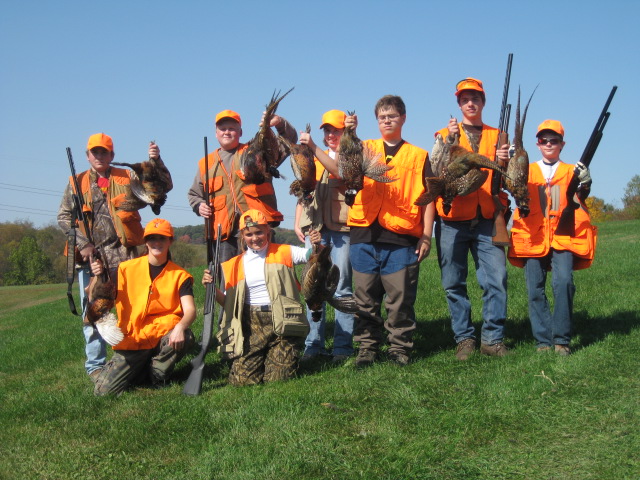
2017 Youth Pheasant Hunt At Bull Creek October 14th!

The 12th annual Youth Pheasant Hunt at Bull Creek is sponsored by the PA Game Commission.  Registration is going on now through September 22nd.  Youth age 12 to 16 may participate FREE.  Sign up by clicking on this link . There are only 30 spots available, first come, first serve. This shoot is open to the public.  You do not need to be a Bull Creek member.  Morning pastries and coffee will be provided. Please follow this link for more details and to register 

Particpants mus be 12 years of age by October 14th


Wednesday, September 6, 2017

Deer disease spreads weeks before early PA archery season

Since the confirmation Aug. 17 of an outbreak of a lethal white-tailed  deer disease in southwestern Pennsylvania, the count of dead deer has risen from 150 to 450. More deaths are expected.
Less than three weeks before the start of the early antlerless archery season in Wildlife Management Unit 2B, the state Game Commission is investigating the spread of epizootic hemorrhagic disease in Allegheny, Beaver and Washington counties. It was first confirmed as the cause of a deer’s death in Greene Township, Beaver County.
The viral disease cannot be contracted by humans but could threaten livestock. EHD is not related to a more serious problem for Pennsylvania deer, chronic wasting disease, and cannot be spread deer-to-deer. Symptoms include a disheveled appearance, drooling, disorientation and bloody patches of skin. Infected deer are frequently found near water and die from extensive hemorrhages in five to 10 days.
The last major EHD outbreak in southwestern Pennsylvania was detected in August 2007. By November an estimated 1,500 to 2,000 wild deer became infected and died in Allegheny, Beaver, Cambria, Fayette, Greene, Lawrence, Washington and Westmoreland counties. A penned deer in Franklin county also died of EHD.
In 2012 a smaller outbreak spread through parts of Allegheny, Beaver, Greene and Westmoreland counties, as well as Cambria and Crawford counties. About 20 deer were killed by EHD on the grounds of Graterford State Correctional Facility in Skippack, Montgomery County.
The epizootic hemorrhagic virus is common among North American deer but the disease occurs more frequently in Southern states where the small flies that carry it, generically called midges, live longer. The insects die off with the season’s first frost.
Archers could find a dearth of deer in some locations when the season opens next month. The Game Commission noted that there is no evidence that EHD can lead to long-term negative impacts on deer populations. The agency is urging residents to report sightings of sick or dead deer by calling the Southwest Region office at 724-238- 9523.

Saturday, August 19, 2017

2017 Youth Rifle Tournament August 27th! Sign Up Now...

The 9th annual Bull Creek Youth Rifle Tournament will be held Saturday August 27th, 2017 beginning at 11:00 AM. We will have three age brackets with trophies awarded for first, second and third place in each bracket. The entry fee is $5.00 per entrant.

Every entrant will receive a prize bag with items donated by many sponsors who help support this great activity and promote the teaching of safe firearm handling, shooting and marksmanship.

This tournament is open to the public. If you have a son or daughter in any of the age brackets (see entry form) you may print out the the entry form (see below) and either bring it to a monthly club meeting or mail it to the address listed (Do not send money, pay only at the event).

This event has been very successful and offers a great opportunity to learn gun and range safety as well as compete in a structured yet fun atmosphere!


Here is a 3 minute video from the 2014 event:

https://youtu.be/7HYw4xA6iYo


Click on the form below to print


Sunday, July 23, 2017

Pennsylvania Game Commission asks for public support in treating chronic wasting disease

By Bob Frye
Amidst a situation described as “dire” already and potentially “catastrophic” soon, a campaign for the hearts and minds of Pennsylvania's hunters is underway.
Newly discovered chronic wasting disease is the reason.
Pennsylvania Game Commission officials said an adult buck with CWD, as the always-fatal ailment is known, recently was found on state game land 87 in Bell Township, Clearfield County. That's within disease management area 3.
Wasting disease was discovered there previously, in 2014. That, though, was on two captive deer farms.
It never was detected in wild deer there before now, despite the commission having tested 1,012 hunter- and road-killed whitetails, executive director Bryan Burhans said.
Its presence is bad news, given what's at stake.
Burhans said hunting generates $1.6 billion in economic activity statewide annually. Hunting license sales, meanwhile, largely fund the commission.
“The mere existence of chronic wasting disease in Pennsylvania represents a serious risk to our deer and elk herds and hunting and conservation in the commonwealth,” Burhans said.
It's not just one deer jeopardizing that.
Justin Brown, the commission's wildlife veterinarian, said the Clearfield County buck was euthanized by a wildlife conservation officer after exhibiting “clinical” signs of disease. It was emaciated, he said, and lethargic to the point of being unaware of its surroundings.
Given how the disease works, that suggests the deer was sick — and spreading infectious prions on the landscape — for at least one year, and perhaps two, before discovery, said Wayne Laroche, director of the commission's bureau of wildlife management.
So it's probably not one of a kind.
“I think there's a pretty high likelihood that there are” other sick deer out there, Laroche said.
If left unchecked, he said, the disease will spread “exponentially.”
That's how things are playing out elsewhere within the state.
Between 2012 and '15, the commission found — statewide — 22 CWD-positive deer. Then, last year alone, it found 25 more, all wild animals within disease management area 2 in southcentral Pennsylvania.
This year it has confirmed nine more there.
“So we have every reason to believe we'll be on the order of 40 or 50 cases this year,” Laroche said.
If that's not scary enough, discovery of wasting disease in management area 3 has potential to do more harm.
The sick Clearfield County buck was found just 10 miles from the western edge of the state's elk range. Elk, too, are susceptible to CWD.
The idea the state's elk might contract disease is alarming, said Cindy Dunn, secretary of the Department of Conservation and Natural Resources.
She called them the “keystone” of tourism in northcentral Pennsylvania. They, more than anything else, draw visitors to the region to learn about conservation, explore the outdoors and spend money, she said.
“A threat to our elk herd is a threat to conservation in our view, and a threat to tourism and our economy,” Dunn said. “So we view this very, very seriously.”
The Keystone Elk Country Alliance does as well.
Andy Olsen, a biologist with the Alliance, said the Elk Country Visitor Center has drawn more than two million visitors since opening in 2010. They've come from all 50 states and 45 countries.
The fear, he said, is that if wasting disease gets into the elk herd — and leads to fewer elk — that activity will dry up.
“Some business models in the region are based on per capita spending by visitors. So fewer visitors means less income for businesses,” Olsen said.
That's where the campaign — nothing short of a plea, really — comes in.
Burhans stressed the need to aggressively attack the disease, costly though it will be.
The commission has been spending about $1 million a year on wasting disease. He expects that to at least double.
But such investments are “necessary and the right thing to do,” he said.
Dunn and Olsen agreed and said they're behind whatever the commission wants and needs to do, with Dunn going so far as to pledge to “commit resources” to the battle.
And what is the commission's plan?
It will make available 2,800 deer management assistance program permits for disease area 3. They'll allow hunters to kill antlerless deer on public or private ground.
Applications will be available soon, Burhans said.
It also will establish two collection sites — at locations to be determined — where hunters will be asked to drop off deer heads for testing. Using those, the commission will pinpoint where sick deer are coming from.
That leads to perhaps the trickiest part of the commission's response plan.
Next winter, after hunting seasons close, it will use sharpshooters from the U.S. Department of Agriculture to cull potentially hundreds of deer, Laroche said.
The goal, he said, will be to remove highly susceptible family groups and contain or eliminate the disease, as has worked elsewhere.
“This is really the only tool we have, the only method that has shown any success,” Laroche said.
It sometimes has been controversial elsewhere, though.
In Wisconsin, for example, efforts to cull deer met with enough public opposition that they were largely abandoned.
Burhans, Dunn and Olsen called for public support of that work here.
The commission will conduct two public meetings this year — one in disease area 2, another in area 3 — to spread that message. Burhans hopes people will accept the necessity of killing deer for the sake of the overall herd.
“There is still a lot that's unknown about chronic wasting disease. But the methods we are proposing are the best options we have at this time, based on results in Pennsylvania and other states with CWD,” Burhans said.
“If we are going to have any chance of controlling this disease, we will need the support of our hunters, the public and our partners in the legislature.”
About the elk herd
So what happens if chronic wasting disease shows up in Pennsylvania's elk herd?
No one's saying.
The Game Commission has been looking for evidence of the illness in elk. Justin Brown, its veterinarian, said it tests virtually all of the adult elk killed by hunters each fall. It annually tests another dozen or so that seem sick.
“So we feel we have fairly good surveillance,” Brown said.
So far, no elk has come back positive for wasting disease.
But if one contracts it?
Wayne Laroche, director of the commission's bureau of wildlife management, wouldn't commit to trying targeted removal — i.e., sharpshooting — of elk. But he didn't rule anything out, either.
“We're going to have to cross that bridge when we come to it,” Laroche said.
— Bob Frye

Bob Frye is the everybodyadventures.com editor. Reach him at 412-216-0193 or bfrye@535mediallc.com. See other stories, blogs, videos and more at everybodyadventures.com.

Sunday, July 16, 2017

CWD FOUND IN THE WILD IN CLEARFIELD COUNTY

HARRISBURG, PA - Chronic wasting disease has spread to free-ranging deer in an area of the state where it previously had been detected only in captive deer.
The Pennsylvania Game Commission today announced a free-ranging whitetail buck in Bell Township, Clearfield County, has tested positive for chronic wasting disease (CWD).
A news conference about the new CWD-positive deer and the Game Commission’s response will be held on Thursday, July 13, at noon at the Game Commission’s Harrisburg headquarters. The news conference will be available to view on the Game Commission’s social media pages.
The CWD-positive buck was shot by a wildlife conservation officer June 7 on State Game Lands 87 because it showed signs of being diseased. Preliminary tests indicated the buck was CWD-positive, and the final results confirm the buck was infected with CWD, which always is fatal to deer and elk.
The buck was within Disease Management Area 3 (DMA 3), which was established in 2014 after surveillance by the Pennsylvania Department of Agriculture detected CWD at two captive deer facilities in Jefferson County.
Because this buck was located near the center of the 350-square-mile DMA 3, the DMA will not need to expand.
However, the Game Commission is immediately taking steps to increase CWD surveillance within DMA 3.
The Game Commission will be allocating Deer Management Assistance Program permits within DMA 3. Each hunter can purchase up to two of the 2,800 DMAP permits anywhere hunting licenses are sold by requesting permits for Unit 3045.
The permits will become available very soon, likely by July 13.
These DMAP permits can be used to take antlerless deer on public and private lands within DMA 3 during any established deer season. Hunters must acquire permission from private landowners prior to hunting.
Harvest data from DMAP permits will augment CWD surveillance.
All known road-killed deer within DMA 3, and a portion of the deer harvested by hunters, already are tested each year for the disease. The Game Commission is looking to increase this sampling effort and obtain more-precise harvest-location information. Cooperation from hunters will be an important first step to make this happen.
The Game Commission also plans to use sharpshooters in DMA 3, in a small, focal area where the CWD-positive deer was found, in hopes of stopping the disease before it has a chance to grow and spread.
In Pennsylvania, CWD has been an increasing threat. The disease also exists among wild deer in the area of southcentral Pennsylvania defined as Disease Management Area 2. Twenty-five free-ranging deer tested positive for CWD during 2016. And an additional four CWD-positive deer have been detected since, raising to 51 the total of CWD-positives detected within the DMA 2 since 2012.
While the spread of CWD within Pennsylvania is a concern statewide and a threat to the state’s deer and its deer-hunting tradition, this latest CWD-positive within DMA 3 is a concern also because of its proximity to Pennsylvania’s elk range, which abuts DMA 3. More than 100 elk are tested for CWD each year and, thus far, the disease has not been detected among the state’s elk.
“There is no vaccine to prevent deer or elk from contracting CWD, and there’s no treatment to cure infected animals,” said Game Commission wildlife-management director Wayne Laroche. “However, if we can remove the infected animals from this area so they are no longer coming in contact with healthy deer or shedding the prion that causes the disease, we may be able to slow its spread and minimize its effects on deer and elk, and the people who enjoy them.
“It’s important our response is as effective and efficient as possible to attempt to curtail this disease before it becomes well-established in an area where it not only is a threat to our deer, but also our elk,” Laroche said.
While CWD poses a serious threat to Pennsylvania’s deer and elk, there is no strong evidence it can be transmitted to humans. As a precaution, however, hunters are advised not to eat the meat from animals known to be infected with CWD, or believed to be diseased.
There already is a prohibition on removing the high-risk parts of harvested deer from any DMA. Hunters who harvest deer and take it to a meat processor or taxidermist within a DMA are making certain that deer are available to the Game Commission for CWD surveillance.
Laroche said cooperating deer hunters within DMA 3 will play a key role in the CWD surveillance to take place there. If the harvest locations of sampled deer are known, it will be possible to more precisely target management actions, he said.
It doesn’t cost anything to drop deer heads off for sampling, and if a sample tests positive, the hunter will be notified.
Game Commission Executive Director Bryan Burhans said it’s important to respond quickly and directly to the serious threat CWD represents. Response measures in areas where CWD is known to be present improve the chances of limiting the disease to a few areas as opposed to many, he said.
“For the sake of our deer and elk, and their importance to hunters and nonhunters alike, we must do all we can to control this threat in the Commonwealth,” Burhans said.

July 2017 Hunter Safety Course Now Registering!

Our Next course will be Offered on Saturday July 29th from 8AM to 4:30 PM. You may register for the class here.

HUNTER-TRAPPER EDUCATION CLASSES

Sanctioned By
PA Game Commission

All Hunter Education classes MUST be registered for online 
Click Here To Register for July 2017 basic class

These Classes are FREE, but you must pre-register.Space is limitedPlease register early!

Bull Creek Rod and Gun Club's Hunter-Trapper Education classes are held twice a year, in early spring and mid summer. Our last class was held in March, 2017. Classes are taught by 4 or 5 certified instructors who are both Bull Creek club members and trained by the Pennsylvania Game Commission. Plus, volunteers from the club and community assist the instructors with presentations offered in:
  • History of Hunter-Trapper Education in Pa.
  • Knowledge of sporting arms, ammunition, and traps.
  • Safe handling of sporting arms and trapping equipment
  • Wildlife Conservation and Management
  • Wildlife Identification
  • Hunting and trapping laws
  • Hunter-Trapper/Landowner relations and ethics
  • Safe Clothing
  • Outdoor Safety (Emergency first aid and survival)
  • Field care of game
  • Game Law presentation by Game Commission Officers
  • Range Instruction
  • Walk through shoot/don't shoot course
  • Archery Demonstration
  • Tree Stand Demonstration
STUDENT EXAM FOLLOWS COURSE
Eligibility: Student must be 11 years of age or higher to register and receive a training certificate. You MUST have completed this mandatory training and have reached at least 12 years of age to hunt in Pennsylvania.

Call 1-800-243-8519 to reach the Southwest Region Office in Ligonier, PA, for other
class schedules near you.
THESE COURSES ARE FREE!

Read a testimonial: