Sunday, December 14, 2014

Rain Hampers Bear, Deer Seasons; Fishing Interest Increases

By Bob Frye, Trib Total Media

It's been a busy fall, if not the most productive one.

Bear season, while still good, failed to live up to its largest possibilities, while a good portion of the deer season locally appears to have been — in large part thanks to weather — a washout. Only on the fishing front has there been anything out of the ordinary good, though it's early.

Bear season

Going into the statewide bear season, the Pennsylvania Game Commission laid out the possibility of this being a record-breaking year.

Bear numbers were at an all-time high, as was the number of bear hunters. Food supplies, critical to keeping bears out of their dens and active, were good in most places.
The one variable that could screw things up, cautioned biologist Mark Ternent, was the weather.

He called that one.

Facing conditions ranging from icy to foggy to rainy to unusually warm, hunters killed 2,444 bears as of the end of the four-day statewide season. That was down slightly from 2013's pace, when hunters took 2,473 by the same time.

That's not terrible by any means — the 2014 harvest still will rank in the top 10, if not the top five —– but it's not close to a record pace, either.

The state record harvest occurred in 2011, when hunters took 4,350 bears. They bagged 3,154 by the end of the regular statewide season.

Still to be added to this year's harvest figures are the bears taken during the extended portion of the hunt. It overlapped with a portion of deer season in places. This year, for the first time, properly licensed hunters could take a bear from Wednesday through Saturday of the first week of deer season in wildlife management unit 2C, for example.

A good many tried, said Tom Fazi, a supervisor in the commission's southwest region office. But they took only 35 to 40 bears or so, likely because of bad weather, he said.

“We did have groups of guys out looking for them. They were pushing for them,” Fazi said. “They just weren't having much luck.”

A final bear harvest figure will be available after the first of the year.

Deer season

It will take even longer for the commission to release an estimate of how many deer were killed during the 2014-15 seasons. That usually occurs around March.

But the regular firearms season appears to have been slow locally, again at least partly due to poor weather on key days, such as the first Saturday of the season, according to reports.
A spokesman at Espy's Meat Markets in East Huntingdon said the number of deer brought in on that first Saturday — typically a busy day as doe season opens everywhere — was down.

Fazi said he patrolled in Cambria and Indiana counties that day and checked just one hunter with a deer all day.

Pat Snickles, another supervisor in the southwest region office, said he experienced similar things. He recounted a conversation with one hunter, who said he would rather wait for better weather than hunt in a downpour. That seems to be the attitude a lot of hunters took, Snickles said.

Things picked up a bit this past week, especially given some areas had snow, he added.
“But I think that when it's all said and done, this is going to have been just an average season,” Snickles said.

Even that would top what's been seen in some other places.

The West Virginia Division of Natural Resources this past week announced the buck harvest during the two-week firearms deer season, which concluded Dec. 6, was down 34 percent compared to last year. Officials with the Ohio Division of Wildlife likewise said the deer harvest in the seven-day firearms season was down 13 percent.
Fishing licenses

It's early, but fishing license sales are running ahead of last year's pace.

License for the 2015 year went on sale Dec. 1. There hasn't been a rush to get them, but that's not unusual. In a typical year, the Pennsylvania Fish and Boat Commission will sell about two percent of the 800,000-plus licenses in December.

But as of Friday, sales were up about 1.6 percent this year over last, commission spokesman Rick Levis said.

Agency leaders are hoping that's because anglers are taking advantage of a price break.
The commission reduced the price of a general license for 2015 by $1; that break is good all year. For this month only, though, anglers can buy three- and five-year licenses and get $1 off each, a savings of $3 to $5.

“Every time we raise license fees, we lose anglers. We're hoping that by cutting fees we'll bring a few back,” executive director John Arway said.

Whether the “catch the value” campaign will bring back anglers is an unknown. Arway admits it's an experiment.

But the potential to bring new or lapsed anglers back to the sport make it worth the risk, he added.

At least one other state is now trying something similar.

Florida Gov. Rick Scott recently ordered a drop in the cost of the state's lifetime hunting and fishing licenses. The price break is only good until Dec. 31, and it's only open to state residents 21 and younger.

Bob Frye is a staff writer for Trib Total Media. Reach him at bfrye@tribweb.com or via Twitter @bobfryeoutdoors.

Low Harvest During The Rainy Rifle Deer Season May Benefit Late-Season Hunters

 By John Hayes / Pittsburgh Post-Gazette

White-tail deer are the masters of energy conservation. With their insulating hollow hairs and other weather-mitigating features, they're comfortable in snow and seasonably cold temperatures. * But in a miserable combination of rain, wind and cold, they're likely to bed down under cover and wait it out.


■ ■ ■ ■
Hunters also don't like rain, wind and cold. In miserable weather, they're likely to bundle up and hunt from a stationary post, leave early or just stay home.

When hunters don't push bedded deer, there's not a lot of shooting. Throughout Pennsylvania, that was the state of deer hunting during much of the two-week firearm season.

Many skilled hunters -- some who didn't see a deer during those cold, rainy days -- wonder how the probable low harvest will impact the late-season hunts and next year's doe tag allocations.

"I've been out every day. There's been less pressure from what I've seen," said Tom Fazi, education supervisor for the state Game Commission's southwest region. "I anticipate more deer being available during the late flintlock muzzleloader and archery seasons."

Fazi says his assessment is anecdotal -- deer processors he's spoken with say business was down during the rifle season, but overall it's comparable to previous years because of increased archery kills.

Game Commission deer harvest estimates won't be ready until spring. But several data points are worth considering:

■ More than half of the antlered deer killed during the two-week rifle season are taken on opening day. During the 2013-14 seasons 134,280 bucks were harvested.

■ Most hunting hours during the two-week firearm season are logged on the opening day and two Saturdays. Inclement weather Dec. 1 and Dec. 6 reduced hunting pressure, and it's almost certain that fewer deer were killed on those days.

■ In recent years, crossbow use has greatly increased the archery harvest. In 2013-14, 100,700 deer were killed by archers (the buck-to-doe ratio was about 50-50). This year, 7,600 more resident archery licenses were sold than in 2013.

■ Successful hunters are required by state law to submit harvest reports, but reporting has dropped to 25 percent. Harvest estimates are largely determined using other less accurate means.

■ Each year, Game Commission biologists submit to the board a harvest estimate, deer population estimate and recommendations for antlerless allocations and permits for the Deer Management Assistance Program, or DMAP, for each wildlife management unit. The recommendations are based on multiyear trends. Commissioners weigh that data against other considerations -- including the interests of other deer-population stakeholders -- and set seasons, allocations and permits.

Game Commission spokesman Travis Lau said harvest estimates from a single season, or even a single year, usually have little impact on allocations. A bad weather hunting season, he said, would most likely not impact doe allocations.
"Our deer team will tell you it's not necessarily important to have an accurate estimate of the population in one given year," he said. "What is important in management decisions is that you have an accurate understanding of population trends."
Council president Robert Schlemmer of Export said the board may consider a re-examination of antlerless allocations in some WMUs in 2015, but it's not related to weather's impact on the 2014-15 harvest.
Lau said a bigger concern is the increasing failure of hunters to file harvest reports, the most accurate data on deer killed in each WMU.
"I believe people get busy and forget, and there's an intimidation issue," he said. "It's around the holidays, they have a lot going on, and once they remember to report they realize they're beyond the 10 days the law requires and they're afraid they're going to get busted for it."
In fact, said Lau, in most cases the Game Commission does not enforce that state law. It's far more beneficial to get the harvest report, even if it's late.
"There's no talk of changing the law at this time among legislators," he said. "But last year when it came out that reporting was at 25 percent and dropping, there was some talk on the board of making the harvest report mandatory."

Thursday, December 11, 2014

Record-Book Buck To Be Scored Dec. 16 In Harrisburg

Viewers can watch live online to see if the whitetail is the largest on record in Pennsylvania.


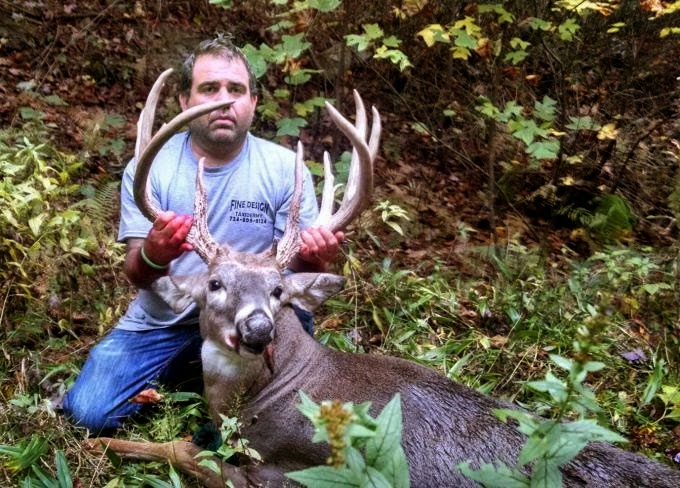
Jeff Lenzi, of Allegheny County, poses with the buck that has potential to top the Pennsylvania records book for typical bucks. Lenzi harvested the buck Oct. 10, and on Tuesday, Dec. 16, he’s scheduled to bring the rack to Harrisburg to have it scored officially and find out if it’s the new No. 1.
Get Image
         By now, you might have heard about an Allegheny County buck taken two months ago during the statewide archery season; a buck so large it might be a new Pennsylvania state record. 

         Will it measure up as the No. 1 buck on record?
         That remains to be seen, but viewers everywhere can watch live online as the buck is measured and its official score recorded 


         Allegheny County hunter Jeff Lenzi, who harvested the massive 10-point buck Oct. 10, is scheduled to bring the rack to the Pennsylvania Game Commission’s headquarters on Tuesday, Dec. 16, to have it officially scored. 


         And the 9 a.m. scoring session will be streamed live on the Game Commission’s website, www.pgc.state.pa.us. 


         Most big-game animals can be measured officially to see where they rank all-time. Pennsylvania launched its Big Game Records Program in 1965, and today, records are kept of all official measurements recorded for white-tailed deer, black bears and elk that meet minimum qualifications for entry into Pennsylvania’s records book. 


         Records are split into a number of categories, based on things such as the configuration of a deer’s or elk’s rack, and whether the animal was taken with a firearm or archery gear. A successful hunter must take his or her trophy to an official scorer. 


         It appears likely that Lenzi’s buck will be scored in the typical category, meaning its rack does not have many abnormal points. While Lenzi’s buck was an archery harvest, but he has said unofficial measurements taken on the rack might make it bigger than any of the typical record-book bucks in the firearms category, as well. 


         It could be the top typical deer of all time in Pennsylvania. 


         To date, the top buck in the typical firearms category was taken way back in 1943 in Bradford County by Fritz Janowsky, of Wellsburg, N.Y. That buck scores 189 inches, based on the Boone & Crockett Club measuring system. 


         The top typical buck in the archery category also is a product of Allegheny County. It was taken in 2004 by Michael Nicola Sr., of Waterford, and its official score is 178 2/8 inches. 


         Minimum qualification for the Pennsylvania Big Game Records book is 140 inches for typical bucks taken with firearms, and 115 inches for typical bucks taken with archery equipment. 


         Official measurements on any deer cannot be taken before the conclusion of a 60-day drying period to allow moisture to evaporate from the antlers and the rack to reach its final size. 


         Lenzi’s buck will be scored by Bob D’Angelo, who coordinates Pennsylvania’s Big Game Records Program. 


         D’Angelo, who said he’d been hearing about the buck long before scheduling the scoring session with Lenzi, said he’s excited to score the rack. The potential new No. 1 has been drawing a lot of interest, too, D’Angelo said. 


         “We are getting plenty of calls from hunters who have heard about the trophy buck, or have seen photos of it,” D’Angelo said. “It does not surprise me a buck of this caliber was taken in Allegheny County. Allegheny County has the second most entries in the Pennsylvania Big Game Records book, behind only Bradford County. 


         “This trophy also could meet the minimum score for inclusion in the Boone & Crockett Club’s records book, which is very difficult to do, and a testament to the trophy deer potential we have in the Keystone State,” D’Angelo said. 


         Pennsylvania entries scored now through the end of July 2015 will be added to the 2015 edition of the Pennsylvania Big Game Records book, if they meet minimum qualifications. The 2014 edition was published in October and can be purchased for $6, plus shipping and handling, through The Outdoor Shop at the Game Commission’s website. Pennsylvania residents must pay sales tax on all purchases.


         Big-game scoring session scheduled 

         Successful hunters who are looking to have their trophies officially scored can do so at a public, big-game scoring session to be held on Feb. 14, 2015, from 9 a.m. to 5 p.m., at the Pennsylvania Game Commission’s headquarters in Harrisburg. 


         Deer, bear and elk that have been harvested in Pennsylvania are eligible for entry into the Pennsylvania Big Game Records book. 


         Deer and elk racks cannot be measured until after a 60-day drying period from when the skull plate was removed from the animal. For bears, the 60-day drying period begins after the skull is thoroughly cleaned by boiling or from the use of beetles. 


         Deer racks to be scored should have at least eight measurable points, and hunters need to register by Feb. 9, 2015. To register, call Patty Monk at 717-787-4250, ext. 3312. For more information on the session, contact Bob D’Angelo at 717-787-4250, ext. 3311.
         All are welcome to attend. 


         The Game Commission’s headquarters is located at 2001 Elmerton Ave. in Harrisburg, just off the Progress Avenue exit of Interstate 81.  

Sunday, December 7, 2014

Penn State Study Revealing How Deer React To Hunters


Deer “know” when hunting season starts and react accordingly, disappearing into nooks and crannies of the landscape where they become almost invisible.

Every hunter has heard that tale. It turns out there's truth to it.

Researchers from Penn State's College of Agricultural Sciences are entering Year 2 of a five-year deer and forest study. It's being carried out on four sites, each measuring 25 to 40 square miles, in Bald Eagle, Rothrock and Susquehannock state forests.

The study has several goals, including:

• Examining deer impacts on forest health and the effectiveness of the measures to monitor it.

• Determining how hunters use the deer management assistance program and how they react to changes in the deer population.

But something else is proving interesting.

As part of their work, researchers have put collars on deer — including bucks that have survived two hunting seasons — and tracked their movements. GPS collars transmit data about deer locations. That occurs every five to six hours in winter, spring and summer and every three hours during archery season. It increases to every 20 minutes during the two-week firearms gun season.

Information collected thus far shows deer react — and not in a small way — to the orange army of hunters nearly 800,000 strong each gun season.

“Their behaviors in archery season, there's nothing to suggest these deer are being impacted by the hunting that's going on to any great extent,” said Duane Diefenbach, leader of the Pennsylvania Cooperative Fish and Wildlife Research Unit, and one of the study's leaders. “But once the rifle season begins, we see some pretty dramatic differences. Some of these bucks will leave their home range and go places we've never seen them in the previous 10 months. It's pretty amazing.”

Equally so is how sensitive those collared whitetails are to pressure, Diefenbach said. They change their patterns almost immediately on the Sunday before the opening day of deer season — when hunters enter the woods to check on their stands, make a last scouting trip or burn off the energy of anticipation — and then go back to their normal routine within a day of the season ending, he said.

“It's like flipping a switch,” Diefenbach said.

And where do all those savvy bucks and does go?

Wherever hunters can't, don't or won't, said Chris Rosenberry, head of the deer and elk section for the Pennsylvania Game Commission and a biologist involved in the study.

He cited the example of one savvy buck. It climbed about 400 feet higher in elevation once hunting season started than it had before and moved further into the woods, so it was about 1,000 yards from the nearest road.

That kind of reaction was typical of deer that survived the season, he said.

“These animals were in areas that are not readily accessible. They went beyond where the hunters were,” Rosenberry said.

It's not true that they become largely nocturnal, Diefenbach said. That commonly held notion appears to be “a lot of bunk,” he said.

Rather, Rosenberry said, deer retreat to places hunters aren't.

“Every one of these animals, if they survive two hunting seasons, have places that either no one goes or that are just so thick. Unless you did a drive, they're just going to walk circles around you,” he said.

Diefenbach said he hopes to send people to walk the ground where these deer hide to see what those spots look like.

In the meantime, the deer are making good use of them. Hunters killed only about 10 percent of collared does and 20 to 25 percent of collared bucks in Year 1 of the study, Diefenbach said.

That so many deer survived is not surprising, at least when it comes to does, Rosenberry said. Multiple studies have shown 85 to 90 percent of does survive hunting season no matter how long the season.

The low buck harvest rate was a little more unexpected, he said. But, he added, as the study is revealing, perhaps they shouldn't be.

“The odds are stacked against the hunter,” Rosenberry said. “These deer are not nearly as predictable as hunters would like them to be.”

Deer and forest health

Ten years ago, if you had asked Duane Diefenbach about the main limiting factor to the lack of forest regeneration, his unequivocal answer would have been white-tailed deer, he said.

Now he's not so sure.

“We've reduced deer numbers. The question now is do we really need to reduce deer numbers more? Or is there some other factor that we need to consider?” the Penn State researcher said.

Specifically, how is overbrowsing by deer coupled with soil conditions, lack of sunlight reaching the forest floor, competing vegetation — from species like ferns and rhododendron — and other factors combining to impact what the forests of tomorrow will look like?

The deer-forest study conducted by Penn State in cooperation with the Pennsylvania Game Commission and Pennsylvania bureau of forestry could offer answers.

Researchers erected new deer exclosures — 20-square-foot areas fenced to keep deer out — representative of the surrounding landscape at various points in four study areas. The plan is to monitor them over time to document what species grow within their confines, in what abundance and how well and quickly, then compare that to what's outside the fence, where deer can browse, Chris Rosenberry of the Game Commission said.

The commission's current deer management program is based, in part, on deer impacts on forest health, he said. That's determined using measures provided by the U.S. Forest Service.

This study might offer insight into how sensitive those measures are and whether they could be made better, he added.

Researchers also want to hear from hunters. They want to know how they're hunting on study areas, whether and how they're using the deer management assistance program and how they rate their hunting experiences.

Hunters interested in getting involved can visit ecosystems.psu.edu/deer or call 877-778-3637.
“We can control how many deer we catch and how many collars we put out. The one thing we have no control over is hunter cooperation,” Rosenberry said. “It's critical they register and provide that information.”
— Bob Frye

Bob Frye is a staff writer for Trib Total Media. Reach him at bfrye@tribweb.com or via Twitter @bobfryeoutdoors.

Wednesday, December 3, 2014

Hunting For The Perfect Gift?

Game Commission selling two new books, and loads of collectibles to please any holiday budget.


          While hunting is often challenging, bagging the perfect gift for the hunters in your life is as easy as placing a phone call or logging onto the Pennsylvania Game Commission’s website.

          Among other gifts available this holiday season, the Game Commission is offering two new books that already are selling briskly and being met with rave reviews.


          Pennsylvania Deer Hunting, Through the Pages of Game News is a collection of classic deer-hunting stories that have been published over the years in Pennsylvania Game News magazine. The 174-page collection was compiled by Pennsylvania outdoor writer Tyler Frantz and sells for $15.50.


Also available is the Pennsylvania Game Commission’s new Game Cookbook, a collection of big-game, small-game and wild fowl recipes submitted by camp cooks from across Pennsylvania. The spiral-bound 108-page cookbook is priced at $9.43.


          The books are among many gifts available either through The Outdoor Shop at the Game Commission’s website, www.pgc.state.pa.us, or by calling toll free to 1-888-888-3459.


          Also popular this holiday season is the 2014 edition of the Pennsylvania Big Game Records Book, which this year is printed in color and contains photos of many of the new entries. And hardcover and soft-cover editions of “Gone for Another Day,” the recent sequel to the classic Ned Smith compilation, are available, as well. 


          There are many new collectible patches, including the nine-patch Youth Hunt series, the 2014 Elk Hunt patch, the 2015 Field Notes patch and the 2015 Working Together for Wildlife patch featuring a groundhog.  


          The Working Together for Wildlife groundhog print also is being offered. 


          And, as always, the latest version of the Game Commission’s wildlife calendar, gift subscriptions to Pennsylvania Game News magazine and a host of other merchandise are available at the website and might just make for the perfect gift.


          There’s something for everybody and something in everybody’s price range.


          The new books will surely bring smiles to the faces of those hunters who might find them beneath the tree.


          Pennsylvania Deer Hunting, Through the Pages of Game News contains some of the best deer-hunting stories ever to be published in Pennsylvania Game News magazine. 


Each chapter represents a different deer-hunting decade, and for each decade, there are three or four different stories, all of which work along the same theme. Frantz, who combed through 960 back issues of Game News to compile the collection, presents these themes to readers at the start of each chapter.


          And as readers turn the pages, they’re treated to a virtual trip through time by stories presented in their original layouts. 


          While some of those layouts are black and white, the book is printed in full color and on high-gloss paper.


          Meanwhile, the Game Cookbook revives a classic publication readers have been clamoring for since the printing of the first edition, published in 1979.  


          A handful of popular recipes from the original cookbook are republished in the second edition, but for the most part, the new Game Cookbook represents a whole new batch of tasty recipes. From groundhog meatballs to pheasant cordon bleu casserole to nearly 70 venison recipes, the Game Cookbook offers tried and true insight into some of the best ways to prepare Pennsylvania’s abundant wild game.


          The cookbook also features color illustrations on how to clean and prepare wild game

for cooking, as well captivating artwork by wildlife artist Doug Pifer. The spiral binding and high-gloss paper create a cookbook that can be used with ease in the kitchen for years to come. 

          Some materials may be available for purchase at the Game Commission’s Harrisburg headquarters, 2001 Elmerton Ave., or at region offices. All orders placed online and by phone are subject to shipping and handling charges, and Pennsylvania sales tax.


          Game Commission Executive Director R. Matthew Hough said that, during this season of giving, the agency is pleased to give shoppers plenty of choices that are certain to please.


          “Searching for the perfect gift is a lot like hunting,” Hough said. “You know that what you’re looking for is out there, but the real trick is figuring out where to find it.


          “I urge anyone shopping for hunters and other outdoor enthusiasts to check out what the Game Commission has to offer this holiday season,” Hough said. “I know many of these items would top my wish list, and it makes me feel good to think how happy they will make all who receive them as gifts.”

Tuesday, December 2, 2014

PA Bear Harvest During Statewide Season Close To Last Year’s Pace

Meanwhile, bear hunting during the extended seasons has resumed in some parts of state.

In the wintry weather that enveloped much of Pennsylvania on Nov. 26, the final day of the statewide firearms bear season, hunters harvested 100 bears, according to preliminary figures released today by the Pennsylvania Game Commission.
That final-day total pushed the harvest during the four-day 2014 season to 2,444, down slightly compared to the 2,473 bears taken during the statewide season in 2013.
Meanwhile, bear hunting during the extended season has resumed in some areas of the state, and is about to kick off in others.
Extended season harvest totals, as well as harvest totals from the bear archery season and other early bear seasons will be released following the close of all bear hunting in late January.
Bears were harvested in 54 counties during the statewide season.
And two of the larger bears in the harvest were taken beyond the season’s midway point.
John L. Thrush, of Boiling Springs, on Nov. 26 harvested a bear estimated at 597 pounds while hunting in Delmar Township, Tioga County; while Gabriel J. Heckman, of Shelocta, took a 579-pounder in Armstrong Township, Indiana County of Nov. 25.
Those bears, by weight, rank as the fourth- and fifth-largest taken during the statewide season.
And with the addition of those bears, the top 10 bears processed at check stations during the statewide season were either estimated or confirmed to have live weights of 557 pounds or more, based on the preliminary totals.
The largest of those bears – a male estimated at 677 pounds – was taken in Pittsfield Township, Warren County by James M. Hultberg, of Pittsfield, Pa, during the Nov. 22 opener.
Other large bears include: a 623-pound male taken in West Buffalo Township, Union County by Fred F. Stoltzfus, of Lewisburg, Pa.; a 598-pound male taken in Muddy Creek Township, Butler County by Jeffrey L. McClymonds of Slippery Rock, Pa.; a 574-pound male taken in Tyrone Township, Blair County, by Ray E. Golden, of Tyrone, Pa.; a 560-pound male taken in Black Township, Somerset County, by Derek J. Wheeler, of Uniontown; a 559-pound male taken in Delmar Township, Tioga County by K.L. Sarangoulis, of Reading, Pa.; a 558-pound male taken in West Branch Township, Potter County, by Colton P. Group, of Landisburg, Pa.; and a 557-pound male taken in Portage Township, Cambria County, by Brett A. Robine, of Irwin, Pa.
With the preliminary totals from the statewide season comparable to last year, hunters are in good position to match the overall 2013 harvest of 3,510 bears, which is the fifth-largest harvest in state history.
The largest harvest – 4,350 bears – happened in 2011, when the preliminary statewide firearms season total numbered 3,154.
The preliminary harvest by Wildlife Management Unit during the statewide firearms bear season was as follows: WMU 1A, 10; WMU 1B, 81; WMU 2A, 1; WMU 2C, 233 ; WMU 2D, 137; WMU 2E, 47; WMU 2F, 249 ; WMU 2G, 571; WMU 2H, 65; WMU 3A, 153; WMU 3B, 199; WMU 3C, 65; WMU 3D, 169; WMU 4A, 97; WMU 4B, 89; WMU 4C, 66; WMU 4D, 176; WMU 4E, 31; WMU 5A, 4; and WMU 5C, 1.
The top bear harvest county in the state during the statewide season was Lycoming County, with 208.
Statewide season harvests by county and region are:
Northwest (364): Warren, 93; Venango, 65; Jefferson, 53; Clarion, 50; Forest, 39; Crawford, 24; Butler, 23; Erie, 13; and Mercer, 4.
Southwest (257): Fayette, 85; Somerset, 83; Armstrong, 35; Westmoreland, 24; Indiana, 18; and Cambria, 12.
Northcentral (1,077): Lycoming, 208; Tioga, 193; Clinton, 149; Potter, 107; Centre, 88; McKean, 85; Cameron, 76; Elk, 73; Clearfield, 69; and Union, 29.
Southcentral (285): Huntingdon, 65; Bedford, 60; Perry, 35; Blair, 34; Mifflin, 29; Fulton, 22; Juniata, 16; Franklin, 11; Snyder, 9; Cumberland, 3; and Adams, 1.
Northeast (411): Pike, 79; Bradford, 57; Sullivan, 47; Luzerne, 45; Monroe, 38; Susquehanna, 32; Wayne, 32; Carbon, 29; Wyoming, 26; Lackawanna, 14; Columbia, 10; and Northumberland, 2.

Southeast (50): Schuylkill, 25; Dauphin, 17; Berks, 3; Lebanon, 2; Lehigh, 2; and Northampton, 1.

Sunday, November 30, 2014

21st Century Has Become Golden Era For Big Game Trophy Bucks

By Bob Frye

The numbers tell the tale: the 21st century has been a historically great time to be a big buck hunter.

The Boone and Crockett Club has tracked big game trophies since 1830. Its record book includes 14,042 whitetails.

It took 185 years, from 1830 to 1999, for hunters to take the first 6,883 of those. That's 49 percent of the total. It's taken them less than 15 years to add the remaining 7,159, or 51 percent.

“It's 100 percent true, the years since 2000 or so have been the golden age of white-tailed deer,” said Justin Spring, assistant director of big game records for the Boone and Crockett Club.

That's been the case all across the country.

The top five whitetail states, by record book entries — Wisconsin, Illinois, Iowa, Minnesota and Kentucky, respectively — all have seen significant jumps in trophy numbers.

Sixty-four percent of Kentucky's “Booners” have been harvested since 2000. It has been 59 percent in Wisconsin, 57 in Illinois, 48 in Iowa and 33 in Minnesota. Ohio, just outside the top five in total entries, put 70 percent of its bucks in over that time.

Similar things have occurred throughout the Northeast. Pennsylvania, for example, could only claim 86 Boone and Crockett bucks going into this season, but 66 percent of them were killed since 2000. Maryland put 50 percent of its bucks in the book since then, New York 48 percent and West Virginia 43 percent.

Credit for much of that here goes to antler restrictions, said Bob D'Angelo, big game records coordinator for the Pennsylvania Game Commission.

Before 2002, hunters could shoot any buck with at least one antler measuring 3 inches long.
Now a buck must have either three or four points on one antler to be legal.

That's made a dramatic difference, D'Angelo said.

“Yeah, we've noticed that. Maybe the last 10 years or so for us, the record book numbers have really increased,” he said.

Brian Murphy, executive director of the Quality Deer Management Association, said hunters all over America are letting bucks live longer, whether required to by regulation or not. The days of shooting any deer with antlers “as tall as a pack of cigarettes” are largely gone, he said. That more than anything is behind the surge in record book entries, he said.

“The culture's just changed. It's a very different world,” Murphy said.

The rise in record book bucks also can be credited to the sheer number of deer available and, to a lesser extent, more awareness of the record book, he added.

If there's any cautionary news, it's that the number of record book entries Boone and Crockett received last year was way down.

“2013 was an epic tank. I mean, it was a total fail,” Spring said.

Some areas of the country, even some of the “bread and butter” states of the Upper Midwest, saw an 80 percent decline in the number of big bucks they produced compared to prior years, he said.

That continued a bit of a recent trend. Spring said the number of record book entries, while still running ahead of decades past, has plateaued since about 2010.
There are a lot of theories as to why.

Some blame predators, Spring said. Others point to loss of habitat or habitat degradation.
A couple of really nasty winters might also have played a role.

Disease is another possibility. Outbreaks of EHD, or epizootic hemorrhagic disease, in 2007 and 2012, either of which alone would have represented a once-in-50-years event, killed a lot of deer nationwide, Murphy said.

The result is deer numbers are down from a record high of 32 million a few years ago to about 26 million now.

Spring is “cautiously optimistic” the number of record book entries is climbing again, though, based on applications he's received so far this fall.

He's hopeful last year was “just a blip.”

“My gut is telling me that we're going to have a better year in 2014, but we won't know for sure until March or April, when most of the records we'll get have come in,” he said.

Bob Frye is a staff writer for Trib Total Media. Reach him at bfrye@tribweb.com or via Twitter @bobfryeoutdoors.

Sunday, November 23, 2014

Allegheny County Buck Could Prove To Be State's Largest Ever Taken

Jeff Lenzi, of Carroll Township, holds the rack from the
giant whitetail he harvested earlier this fall in
Allegheny County. The animal, which he said weighed
302 pounds and had a 27-inch neck, may wind up as
the biggest typical deer ever taken in the state
By Bob Frye

Jeff Lenzi admits he was shaking like he hadn't in quite a few years.


The Carroll Township man was in his tree stand when a large buck — one the landowner nicknamed “Ghost” — walked out of the woods into a meadow. Lenzi looked, then looked again.

The deer was trotting, with its massive rack swaying. Lenzi remembers thinking he never had seen anything like that except on television.

“That's when I thought, ‘Oh, boy.' I started talking to myself, reminding myself to just calm down, to breathe,” Lenzi said.

The deer was a little more than 60 yards away. It seemed as if it were going to pass out of range, so he called on his grunt tube. That stopped the deer instantly.

Lenzi let a bolt fly from his crossbow and the deer went down.

When he found it dead 150 yards later, it was every bit as big as it had seemed.

“When I walked up to it, there was no ground shrinkage at all,” he said. “He was amazing. It's just a beautiful deer.”

And likely a new state record.

Lenzi shot the deer — he won't say where, beyond Allegheny County — on Oct. 10. He scored its typical rack himself, then had four official measurers from the Boone and Crockett Club and Safari Club International do the same.

They came up with the same figure: 1947/8.

That's not final. The rack must go through a 60-day drying period, then be scored again.
It's not uncommon for green-scored deer to “shrink” a bit over that time, so its score could go down a bit, said Bob D'Angelo, big game records coordinator for the Pennsylvania Game Commission, who will give the deer a final score in Harrisburg in early December.

But there's no denying its potential, he added.

Pennsylvania's record typical archery buck was killed in Allegheny County in 2004 by Michael Nicola Sr. of Waterford. It scored 1782/8.

The biggest typical to come out of the state, period, was taken with a firearm in 1943 by Fritz Janowsky in Bradford County. It scored 188.

Barring something unforeseen, Lenzi's buck easily will set the archery mark, and it might top Janowsky's buck, too, D'Angelo said.

“I haven't seen the rack in person yet, and I don't usually like to talk about scores based just on pictures, but it looks like it might score in the low 190s or at the very least the high 180s,” D'Angelo said. “If that score holds, and it looks like it will just from the photo, it's probably got a good chance to be the new No. 1.”

That would put the buck high in Boone and Crockett's all-time record book, too.
There were 8,824 typical whitetails listed going into this fall. The biggest is the famous Milo Hanson buck. Killed in Saskatchewan in 1993, it scored 2135/8. Janowsky's deer ranks 222nd.

If Lenzi's deer scores between 190 and 1947/8, that would rank it no lower than 164th all time and perhaps as high as 60th.

Its rack has 10 main points, all of them long and thick like hickory hammer handles, and a 19-inch spread. Even the brow tines are nearly 10 inches tall.

What really makes it special, though, is its mass, said Lenzi, a taxidermist who sees his share of big deer.

“The girth on this thing is just insane,” he said. “It's just very unique, very heavy.”

Louis Cowger owns the Allegheny County property where Lenzi got his deer. It's posted against trespassing, as are the other properties on three sides of it, and only a few people are allowed to hunt there.

That's produced a lot of big bucks over the years, Cowger said.

“We've always had those kind of deer around. But come hunting season, we often don't see them,” he said.

He's glad Lenzi got “Ghost,” which gained its nickname for its whitish rack and ability to disappear. No one had seen it for weeks before Lenzi shot it.

“People ask me, ‘Aren't you mad he shot that deer instead of you?' But I'm not mad. I'm proud he got it off our land,” Cowger said.

For his part, Lenzi said he'd passed up a number of other legal bucks this fall, letting them walk because they weren't anything he “wanted to end the season with.”

“Then this deer came out, and I wasn't letting it go,” he said. “I knew he was big. But something like that, it's a once-in-a-lifetime thing.”

Bob Frye is a staff writer for Trib Total Media. Reach him at bfrye@tribweb.com or via Twitter @bobfryeoutdoors.