Sunday, October 14, 2012

Presence Of Chronic Wasting Disease Will Prove Costly

By Bob Frye Tribune-Review

The announcement last week that chronic wasting disease was discovered in the state does not signal the end of Pennsylvania’s deer herd. But make no mistake, say the experts: Pennsylvania, its Game Commission and sportsmen are about to go down a serious, expensive path.
 
Wasting disease, or CWD, has so far been found in just one doe on one hobby-type deer farm in New Oxford in Adams County. The remaining deer at that facility will be euthanized and tested, said Craig Shultz, veterinarian with the Pennsylvania Department of Agriculture. The farm and two others — one in Lycoming County, another in York — where the deer was known to have been during its lifetime have been quarantined, too.
 
What happens next with the state’s CWD response plan “all depends on further testing,” Shultz said. “This is all very preliminary,” he said.
 
What’s likely is that CWD is soon going to wind up in Pennsylvania’s wild deer herd, if it’s not there already, predicted Kip Adams, a certified wildlife biologist and director of education and outreach for the Quality Deer Management Association in Pennsylvania.
 
That’s been the pattern in a lot of states, Adams said. Missouri, for example, found CWD in a captive deer herd in 2010. In 2012 — after years of sampling wild deer with no evidence of the disease found — CWD showed up in wild deer on property near the infected facility, he said.
 
“I’m fully expecting them to find more CWD-positive deer here, in the wild, just because that’s what everybody else has experienced. I don’t see why Pennsylvania would be any different,” Adams said.
 
Just looking for it is likely to be costly at a time when federal funding for CWD surveillance has dried up. In recent years, the U.S. Department of Agriculture dispersed $17 million to $19 million annually to help states look for CWD. Maryland, for example, got $75,000 for CWD monitoring in 2010. In 2011, after the discovery of one CWD-positive deer in the wild, it got $180,000.
 
This year — with the money available to states slashed to about $750,000 — Maryland isn’t getting anything, said Brian Eyler, deer project leader for the state’s Department of Natural Resources. The department will have to pay for a scaled-back surveillance program, using money that otherwise would have been directed to wildlife management, habitat creation and hunter issues, he said.
 
“We’ll still be able to do our testing, but instead of it being a Cadillac, it will be a Yugo,” Eyler said.
 
The presence of CWD often leads to regulation changes, too. In Colorado, where CWD is thought to have contributed to regional declines in mule deer populations approaching 40 percent, deer licenses have been limited. West Virginia has outlawed the feeding and baiting of deer in counties with CWD since its discovery in 2005. Maryland has done the same while also prohibiting the movement of most deer parts out of its CWD zone.
 
Pennsylvania could conceivably see any and all those regulation changes, Adams said.
The presence of the disease will not mean the end of hunting, though, if history is any guide.
In West Virginia, CWD has caused some people to change their behavior and switch hunting locations, said Paul Johansen, assistant chief of game management for the Division of Natural Resources. But hunters haven’t given up their sport.
 
“It has not shut hunting down, and that’s a good thing,” he said
 
Pennsylvania can only hope that’s the case, with a disease no one wanted to see finally within the borders.
 
Details
In most places, when you get chronic wasting disease, you have it forever.
The prions that carry the disease persist in soils for “a very, very long time,” said Mike Miller, veterinarian for the Colorado Division of Parks and Wildlife and the nation’s leading CWD expert.
The disease was discovered at the Foothills Wildlife Research Facility in Fort Collins, Colo., in 1967. In 1985, Colorado wildlife officials treated the soil there with chlorine, removed it, applied more chlorine to what was left, then let the facility sit vacant for a year. When they brought more deer in, they contracted CWD.
The one place where CWD was found, then apparently disappeared, was New York. It popped up in five captive deer and two wild ones in 2005.


Despite Favorable Conditions, Pennsylvania's Grouse Count Low

Pennsylvania hunters should see an outstanding grouse season, by all indications except one -- the absence of grouse.
As the first leg of a three-part split season opens this weekend, the Pennsylvania Game Commission's go-to person on ruffed grouse said spring research and summer sightings don't add up, resulting in a recent advisory that grouse hunting was expected to be "slightly below average."
"Conditions were good in winter and spring, with a lot of early reports of plenty of broods by June 1. Then as summer came, our people in the field were filing reports saying [grouse] numbers were down, down, down," said Game Commission grouse and woodcock specialist Lisa Williams. "It didn't make sense. I was scratching my head, because my gut still tells me we should see a lot of grouse out there."
Pennsylvania's official state bird is North America's most widely distributed resident game bird. While the grouse population has declined in the state since 1980, and the number of hunters targeting them is down, more than 100,000 Pennsylvania hunters are expected to harvest 75,000 to 100,000 grouse in the 2012-13 seasons, contributing some $79 million to the state's economy, according to a Game Commission report.
Ruffed grouse can be found in most forested areas. But like the woodcock and song birds with whom they share the thickets, grouse are habitat specialists preferring what Williams called "really thick, gnarly stuff." Serious grouse hunters know they'll have to get physical in grape tangles and dense stands of seedlings and saplings to force an adrenaline-inducing flush.
Pennsylvania Grouse Cooperators -- a group of 314 hard-core grouse hunters who keep track of their hunts and report back to the Game Commission -- documented 1.32 flushes per hour last season, the highest flush rate among neighboring states. But Pennsylvania has been tough on grouse.
"Losses of young forest habitat over the last several decades have been bad news for grouse, woodcock and other species that rely on these habitats," said Ian Gregg, Game Commission Game Bird Section supervisor, in a written statement.
Young forests up to 20 years old dropped from nearly 20 percent of total forest acres in 1980 to a little over 10 percent today.
A 10-year plan for rehabilitating the grouse population adopted in 2011 by the Game Commission fits into the framework of a 2008 North American Ruffed Grouse Conservation Plan developed by the transnational Association of Fish and Wildlife Agencies. The state plan, cowritten by Williams and Gregg, calls for raising the percentage of young forest acreage to 17.3 percent, which is expected to add 2.75 million acres of young forest growth by 2020. To do that on state game lands, state forests and other public and private lands, the state will have to test new habitat management strategies detailed in the North American plan and tailored to Pennsylvania's unique landscape and mix of forest types.
The decline in grouse populations began to ease in 2004-05, when spotty evidence of reconstituted forest regeneration was reported in some wildlife management units.
"As I look back at deer management since 2000, it really does kind of fit that as deer were brought into better balance [with habitat], species that like new growth would benefit," said Williams. "But I'm not sure we have the data to say that yet."
This year's unusually mild winter and spring created ideal conditions for grouse. Broods were plentiful and chick mortality should have been low.
So where are all the grouse?
"I'm not sure, but I have some ideas," Williams said. "Our summer reporting is observational. As our foresters and other people are working on jobs in the field, they keep track of the number of grouse they see. It's not a great method, but typically those numbers are a good indication of what we'll see in the fall."
Unusually dry summer weather may have screwed up the count.
"A drier summer could have led the grouse to pull back into wetter, more lush areas where there were plenty of green leaves -- we call it 'salad' -- where our people couldn't see them," she said. "I think the [summer] numbers being down has more to do with the survey than with the actual population. My gut -- and that's all it is -- tells me this is going to be a good season. The grouse will tell us what's what."

Thursday, October 11, 2012

PA's First Case Of Chronic Wasting Disease (CWD) Has Been Found In A Captive Deer

By Bob Frye, Pittsburgh Tribune Review


The first case of chronic wasting disease in Pennsylvania has been discovered.

The Pennsylvania Game Commission and Pennsylvania departments of Agriculture and Health announced Thursday that a sick doe was found on a deer farm in Adams County.

That facility — described as a hobby-type operation — has been quarantined, as have two other facilities, one in Lycoming County and another in York. Those “farms” do not have deer currently, but because CWD can persist in soil for “a very long period of time” and the sick doe is known to have been at each during its lifetime, no deer can be moved onto or off of any of the sites, said Craig Shultz, chief veterinarian with the Department of Agriculture.

The remaining deer at the Adams County farm likely will be euthanized and their brains tested to see if any of them also have CWD, Shultz said. “Depopulation of the facility is really the only choice we have. There is no live animal test,” he said.

Wasting disease, known as CWD, is a fatal ailment that attacks deer, elk and moose. There is no evidence it can be transmitted to humans, according to the Centers for Disease Control and Prevention and the World Health Organization.

Officials were quick to say that efforts are under way to contain the disease.

“Pennsylvania has an aggressive chronic wasting disease surveillance program and a strong response plan,” said Agriculture Secretary George Greig. “Steps are being taken to prevent further spread of this disease to the state’s captive and wild deer populations.”

An interagency CWD task force that includes representatives of the departments of Agriculture, Environmental Protection and Health, the Game Commission and the U.S. Department of Agriculture met Thursday. They will “carry out the state’s CWD response plan, which includes education and outreach with public meetings and minimizing risk factors through continued surveillance, testing and management,” a news release said.

The Game Commission was planning to hold its own internal meetings Friday, spokesman Jerry Feaser said.

“Our focus is going to be solely on what we’re going to do with the areas immediately around these farms. And no decisions have been made,” Feaser said. “Our level of response will be directly related to what we know. So far what we know is this is one deer on one farm.”
CWD was first discovered in Colorado captive mule deer in 1967. It was largely a disease of the western United States. It was not found east of the Mississippi River until 2002, when it showed up in Wisconsin. It’s since spread to 23 states and Canadian provinces, with Iowa and Missouri also finding it for the first time in 2012.

It has not been found in any wild deer in Pennsylvania, despite the fact the Game Commission has tested 38,000 whitetails and elk since 1998.


More from the Game Commission and Dept of Agriculture:

Because the deer was not in a wild population, the Department of Agriculture is heading up the response. Here is a link to their CWD webpage. 
http://www.agriculture.state.pa.us/portal/server.pt/gateway/PTARGS_0_2_24476_10297_0_43/AgWebsite/Page.aspx?name=Chronic-Wasting-Disease-Information&navid=0&parentnavid=0&pageid=138


The Pennsylvania Department of Agriculture confirmed the first positive case of Chronic Wasting Disease (CWD) in Pennsylvania in October 2012. CWD is a progressive, fatal disease of the nervous system of cervid animals including deer, elk and moose. CWD is not believed to be transmissible to humans.
An interagency CWD task force is in place to address the threat of the disease to Pennsylvania’s captive and wild cervid populations and includes the departments of Agriculture, Environmental Protection and Health, the Pennsylvania Game Commission and the U.S. Department of Agriculture. The task force is currently following the Chronic Wasting Disease Response Plan to prevent further spread of this devastating disease to the state’s captive and wild cervid populations.

Wednesday, October 10, 2012

Pennsylvania Game Commission Posts Maps Of State Game Land Roads

HARRISBURG – Pennsylvania Game Commission Executive Director Carl G. Roe today announced that the agency has developed and posted an online listing of maps that depict roads opened seasonally to provide hunters and trappers greater access into interior portions of State Game Lands.
 
“These roads are opened to provide hunters and trappers better access to the State Game Lands system, which is a priority for the agency,” Roe said. “Statewide, we have more than 400 miles of seasonally-opened roads on State Game Lands. These roads are important to the public; their seasonal openings are based on hunting seasons, road conditions and safety.
 
“From time to time, we close some of these roads when conditions warrant.  In the past, we have been forced to close roads due to storm run-off following hurricanes, or excessive snow.”
 
To access the information, go to the Game Commission’s website (www.pgc.state.pa.us), and click on “Seasonal SGL Road Openings” in the “Quick Clicks” box in the right-hand column.  From this page, choose the region of interest to view its listing of State Game Lands with seasonally-open roads, the period each road is opened, and a map to help pin-point the road that is open.  To open the map, click on the State Game Land number.
 
For a more detailed map of each State Game Land, select “State Game Lands Maps” in the center of the agency’s homepage or under “Quick Clicks.” Then choose the region of interest from the map.  The region map will enable you to identify the State Game Land number of interest, which you can then select in the drop-down menu under “State Game Lands Maps.” 

Sunday, October 7, 2012

Array of Pennsylvania Hunting Seasons Kick Off

By Bob Frye Pittsburgh Tribune Review
 
If you’re an outdoorsman and you can’t find something to do this month, you’re just not trying.
 
October — not even counting the archery season, already under way — presents all kinds of opportunities to hunt for everything from Pennsylvania’s biggest game to small game. And this week starts the busiest of busy times.
 
Squirrels
Squirrel season starts Saturday and runs through Nov. 24. These are boom days for squirrels, with populations as high as they’ve been in decades, said Tom Hardisky, a biologist with the Pennsylvania Game Commission.
“There are squirrels just about everywhere you look. There’s no shortage of them,” Hardisky said.
Last year, an estimated 690,141 squirrels were harvested by hunters. To find them, Hardisky recommends looking for mast-producing trees such as walnut, butternut, oak and hickory.
Junior hunters can chase squirrels — as well as pheasants — through Friday, and rabbits through Saturday, in special youth only seasons, too.
 
Ruffed grouse
Grouse hunting still has its followers, but this season — which opens Saturday and runs through Nov. 24 — might be a rough one for them.
Sightings of adult grouse and broods were off this spring, indicating that populations will be slightly below average this fall, commission biologist Lisa Williams said.
The hunting in the northwest and northcentral regions likely will remain “good to excellent,” though.
Warren, Forest, McKean, Potter, Elk and Cameron typically produce the most flushes and birds. Things will be only “fair” in the southwest.
Statewide, hunters averaged about 1.32 flushes per hour on their way to taking 52,000 grouse last year.
 
Antlerless deer
Pennsylvania’s early muzzleloader season for antlerless deer and its early rifle doe season for junior and senior hunters start this coming weekend.
The muzzleloader season runs from Oct. 13-20, and the junior/senior season is Oct. 18-20.
The hunts, less than a decade old, draw a decent crowd. As you’d expect, though, those carrying more modern firearms take more deer.
The muzzleloader season attracted 65,000 hunters who took about 6,000 deer last year, said the Game Commission’s Jerry Feaser. The rifle season drew about 32,000 hunters who took about 9,000 deer.
Hunters can take one antlerless deer, provided they have a valid doe tag or DMAP coupon.
 
Black bears
This year, for the first time ever, hunters can kill a bear during the muzzleloader and three-day rifle deer seasons, though only in wildlife management units 2B, 5B, 5C and 5D. A few bears have already fallen to archers.
Carl Roe, executive director of the commission, told board members in Franklin that a 12-year-old girl hunting with a crossbow in Lehigh County shot a 165-pound bear. She is the first person to take a bear in the extended season.
Not far behind was 17-year-old Aaron Hwosdow of West Deer, who shot a 350-pounder in Allegheny County while bowhunting for deer.
 
Waterfowl
Duck hunting in the so-called “south zone” — which takes in all of Pennsylvania south of I-80 — runs Oct. 13-20. The early season is prime time for taking species like wood ducks, according to commission data.
The bag limit is again a liberal one. Hunters can take six birds a day, counting all species.

Friday, October 5, 2012

Game Commission Praises Jury Decision In Adams County


HARRISBURG – Pennsylvania Game Commission Executive Director Carl G. Roe today issued the following statement after a jury in Adams County sentenced Christopher Johnson to death for the first-degree murder of Wildlife Conservation Officer David L. Grove.
“We believe that justice has been served with these jury decisions,” Roe said. “We offer our sincere thanks and appreciation to Adams County District Attorney Shawn Wagner and Montgomery County Assistant District Attorney Kevin Steele for their prosecution of this case, and to the Pennsylvania State Police who conducted an exemplary investigation of this murder.
“This case has been a heart-wrenching, two-year experience for our entire agency. While the loss of WCO Grove will never be filled, we know that his spirit will be among us as we continue to do our duty to protect and conserve Pennsylvania’s wildlife resources; a duty to which WCO Grove had dedicated his ‘last full measure of devotion.’”
WCO David L. Grove was shot and killed in the line of duty while on patrol around 10:30 p.m., on Nov. 11, 2010, along Shrivers Road in Freedom Township, Adams County.
Grove, age 31, of Fairfield, Adams County, was investigating reports of ongoing night-time shooting and possible poaching activity in the area.
Prior to this incident, the last Game Commission Officer to have been shot and killed in the line of duty was Game Protector Joseph McHugh in Weatherly, Carbon County, on Nov. 7, 1915. In that case, the jury found the offender, Francis Thomas, 19, from Drifton, not guilty

Tuesday, October 2, 2012

Average Pennsylvania Grouse Hunting Expected Overall


HARRISBURG – Pennsylvania Game Commission biologists expect ruffed grouse hunting to be average to slightly-below average for the nearly 100,000 hunters who annually pursue these challenging game birds.
“Conditions for over-wintering, incubating and brooding should have supported good reproduction this year,” said Lisa Williams, Game Commission grouse and woodcock biologist. “However, our Game Commission field staff observed fewer adult grouse and grouse broods this summer compared to prior years. Those sightings are often the best predictor of the season, so I advise hunters to hope for the best but keep their expectations realistic. Find areas of good dense cover and abundant food supply and you’ll put yourself in the best position for success.”
The first segment of the state’s three-part grouse season opens Saturday, Oct. 13, and runs through Nov. 24. The season reopens Dec. 10 to 24, and then again from Dec. 26 to Jan. 26. Participating hunters must have a valid Pennsylvania hunting license and follow the regulations that govern this rugged sport of brush-busting and mountain-scampering. Wherever you hunt grouse, there is ample reason to carve out some time afield this season. Just be sure to take time to locate high-quality coverts that provide a good mix of food and cover.
“Losses of young forest habitat over the last several decades have been bad news for grouse, woodcock and other species that rely on these habitats,” said Ian Gregg, Game Commission Game Bird Section supervisor. “Our forests are getting older, and that’s a negative for grouse. But, the good news is that the Game Commission is taking an active approach to improving the situation for grouse and other species that rely on young forests. We have Grouse and Woodcock management plans that call for aggressive management of young forest habitats, and Game Commission staff in all regions are actively working to create suitable habitat – not only on State Game Lands, but on cooperating State Forests and other public and private lands. This work benefits multiple species and our efforts have received an overwhelmingly positive response from the public and from our conservation partners.”
Pennsylvania’s state bird is holding its own in areas of suitable habitat, and in some areas, thriving. Statewide, the Game Commission’s 314 active Grouse Cooperators hunted 7,787 hours and recorded 10,249 flushes for an average rate of 1.32 flushes per hour during the 2011-2012 grouse season. This 2011-2012 flush rate was equal to that of the previous season but six percent below the long term (46-year) average of 1.41 flushes per hour. Embedded in those statewide averages, however, are memorable hunting experiences, with many hunters recording four to five flushes per hour in areas of good food and cover.
Williams noted that Pennsylvania consistently maintains the highest flush rates among nearby states such as Kentucky, Maryland, New York, New Jersey, Ohio, West Virginia and Virginia.
“Grouse flush trends in most of our neighboring states show a continuing long term decline,” Williams said. “Over the past six to seven years, Pennsylvania flush rates have exceeded those of all neighboring states. During that time, our grouse population index has stabilized in some regions that were previously declining, and even increased in some portions of the Commonwealth. Anecdotal reports from grouse hunters as well as agency land managers and foresters suggest that forest understory conditions have improved for grouse as deer numbers were brought back into balance with their forest habitats. I intend to further investigate this link between deer impacts, forest habitat quality and grouse numbers.”
Grouse hunting remains a popular fall pursuit in Pennsylvania. According to the agency’s Game Take Survey, an estimated 80,000 hunters took 52,000 grouse during the 2011-12 seasons, during 350,000 days afield. Though fewer than in the past, grouse hunters remain passionate about their quarry, and the ruffed grouse remains a popular game bird in the Commonwealth. Yet grouse hunter numbers remain well below those of the mid-1980s when Pennsylvania had more than 400,000 hunters pursuing the thunderbird.
“Several hunters have told me they can hunt all day and not see another grouse hunter,” says Williams. “For hunters seeking a season with a little more elbow room yet plenty of challenge, you might want to consider grouse hunting.”
The Game Commission conducts a Summer Sighting Survey in which Game Commission foresters and surveyors record numbers of broods and individual grouse seen while working in the woods during June, July and August. Trends in hunters’ fall flush rates follow those of the summer survey about 80 percent of the time, so this information is used to develop the season forecast.
“Sightings of adult grouse during the summer of 2012 were down roughly 40 percent and brood sightings were down 25 percent compared to last year,” Williams said. “Looking a bit further back over time, observations of both adults and broods this summer are down 25 percent from the most recent 10- year averages. So in spite of what I believe was a good year for reproduction, I’m forecasting an average to slightly below-average grouse season in 2012-13. This makes it particularly important to understand the characteristics of good grouse habitat, locate high-quality coverts, and focus your efforts there.”
Grouse and woodcock hunters are urged to participate in the Game Commission’s Grouse Cooperator Survey, which enables the agency to monitor long-term changes in grouse populations in good habitats. Hunters of all skill levels are welcome, no matter how many days they are able to devote to grouse or woodcock hunting. For each day hunted, participants are asked to record the county and number of hours hunted, and number of grouse and woodcock flushed and bagged.
Hunters interested in participating in the Cooperator Survey are asked to contact the Pennsylvania Game Commission, Bureau of Wildlife Management by calling 717-787-5529, or writing to: Pennsylvania Game Commission, ATTN: Grouse Cooperator Survey, 2001 Elmerton Ave., Harrisburg, PA 17110-9797. New Cooperators will receive a copy of the annual newsletter provided to all survey participants and all forms needed for the upcoming season.
“Though cooperator information is presented as state or region averages, it is important to remember that statewide trends do not apply equally throughout Pennsylvania,” Williams emphasized. She groups Pennsylvania regions into three categories, as far as grouse hunting prospects:
1) Northwest and Northcentral: good to excellent. These regions are consistently the top two in the state and have maintained grouse flush rates at or above their long-term averages in recent years. The rate of timber harvest over the next few decades in this part of Pennsylvania may put enough land into good grouse cover that the “good old days” are just ahead. The six contiguous counties of Warren, Forest, McKean, Potter, Elk, and Cameron typically have the highest flush rates in the state and offer plenty of acreage in public and open-access private lands for hunters looking for new coverts.
2) Southwest, Southcentral and Northeast: fair. These regions maintain intermediate flush rates and habitat conditions with somewhat less extensive overall forest cover and lower rates of active forest management at a large landscape scale. From 2010-2011 to 2011-2012, flush rates increased slightly or remained stable in each of these regions.
3) Southeast: fair in areas north of the Blue Mountain and poor south of it. Large parcels of forest habitat in southeastern Pennsylvania were already scarce and this region has lost early successional habitat even more rapidly than the rest of the state. Consequently, grouse hunting opportunities in the agricultural and urban-dominated landscapes south of the Blue Mountain are extremely limited. Again, locating high-quality habitat is key and taking the time to scout for grouse food and cover hotspots prior to the season may pay dividends.
Grouse hunters are reminded to wear at least 250 square inches of fluorescent orange clothing on the head, chest and back combined at all times; limit hunting parties to no more than six individuals; and plug shotguns to three-shell capacity (magazine and chamber combined).

Sunday, September 30, 2012

Pennsylvania WCOs To Enforce State ATV Regulations


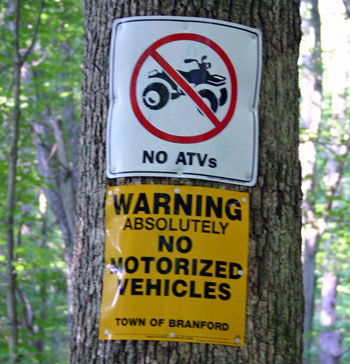
As Pennsylvania bow hunters take to the woods during the first of two antlered and antlerless archery deer seasons (Sept. 29-Nov. 12, Dec. 26-Jan. 12), the state Game Commission has taken action to ease one of archers' greatest annoyances.

Some riders of all-terrain vehicles routinely violate laws restricting their access to state-maintained hunting grounds. Unauthorized ATV use is one of the most frequent violations encountered by Wildlife Conservation Officers, but state law requires WCOs to contact other law enforcement authorities in some ATV cases. Offending operators often get away to destroy more habitat and disturb more wildlife.

A regulation passed last week during the Game Commission's fall meeting permits WCOs to enforce requirements regarding registration and insurance carried by operators on state game lands and private properties enrolled in the agency's Hunter Access Program.

"Illegal ATV operation is a major source of wildlife habitat destruction across the state, and these violations are often accompanied by ATV classification offenses, such as a lack of registration or insurance," said Carl Roe, Game Commission executive director, in a written statement. "This amendment will ensure safe and effective enforcement of these requirements occurring on lands under Game Commission ownership, lease, agreement or control."

Pennsylvania Bill Resulting From Disagreements Over Deer At Issue


Just in time for archery season, we've got another argument about white-tailed deer on our hands.

On Oct. 2, the House of Representatives State Government Committee is scheduled to vote on House Bill 2073. Sponsored by Rep. David Maloney of Berks County, it would put the Pennsylvania Game Commission under the authority of the Independent Regulatory Review Commission. That group would review every proposed wildlife regulation and recommend to lawmakers and the governor whether they are acceptable or not.

Make no mistake — this is all about deer.

Maloney has been highly critical of the Game Commission’s deer program and said last fall he believes the agency is being unresponsive to hunters. This could change that, he said then.
But now, with word out that the bill might be amended to put the Fish and Boat Commission under review, too, some sportsmen are rallying against it. The Pennsylvania Federation of Sportsmen’s Clubs will on Monday ship a letter to members of the State Government Committee asking that they vote against the bill. It’s also asking hunters to carry the same message to their local lawmakers.

“We’ve heard that the members are being flooded with emails. We hope to keep that pressure up,” said Melody Zullinger, former executive director of the Federation who now consults with the group.

The letter notes both the Game and Fish and Boat commissions already have to conduct their business publicly. Adding the Review Commission would just slow things down, to the point that the Game Commission in particular would have to set seasons and bag limits more than a year in advance.

“Members of IRRC (a purely political group, appointed by legislators, with absolutely no expertise or experience in wildlife management, habitat management or sportsmen’s issues, and who may or may not be anti-hunters) and the legislature will get final say on every single proposed regulation,” the letter reads.

“Just by failing to act in a timely manner ... they could literally cripple our agencies’ ability to effectively manage our wildlife resources in a manner conducive to sportsmen’s and/or the resources’ best interests.” The letter is signed by president Chuck Lombaerde.

Stan Rice, moderator of the HuntingPa.com forum, also opposes the bill because it would impact regulations for all species, along with things like game lands purchases.

“Oppose the deer program if you must. Hate the Game Commission if you must. But understand, this bill is deadly poison to our sport in this state,” Rice said.

Tuesday, September 25, 2012

PA Game Commission Board Seeks To Expand Mentored Youth Program For 2013-14

FRANKLIN, Venango County – The Pennsylvania Board of Game Commissioners today gave preliminary approval to a regulatory change to expand antlerless deer hunting opportunities under the Mentored Youth Hunting Program (MYHP) for the 2013-14 license year. 

“Sporting organizations and other interested groups have continued to express an interest in having the Game Commission expand the MYHP opportunities,” said Ralph A. Martone, Board President. “These groups support this proposed change in regulations to permit the transfer of no more than one Deer Management Assistance Program (DMAP) permit to a mentored youth hunter per license year. 

“This change, along with the recent addition of fall turkey hunting to the MYHP, creates a wide range of opportunities for young hunters.

Martone noted that this action will not significantly affect the DMAP antlerless deer harvest and is consistent with the goal of providing additional mentored youth hunting opportunities. Also, it will work in the same manner as the recent change in regulations to allow adult mentors to transfer one Wildlife Management Unit-specific antlerless deer license to a mentored youth.

If the change is given final approval at a subsequent Board meeting, beginning in the 2013-14 license year, adult mentors would be authorized to transfer one DMAP harvest permit issued to them to an eligible mentored youth.  The DMAP harvest permit must be valid for the property on which the pair is hunting, and in the possession of the adult mentor at all times while hunting antlerless deer.  Adult mentors may transfer the DMAP harvest permit to mentored youths only after the youth harvests an antlerless deer.  A mentored youth may receive by transfer no more than one DMAP harvest permit each license year. 

As is the case with antlerless deer licenses, a mentored youth is ineligible to make direct application for a DMAP harvest permit.

“Since 2006, Pennsylvania’s hunters have been taking advantage of a remarkable opportunity to introduce those under the age of 12 to hunting through the Mentored Youth Hunting Program, and we have seen a steady increase in the number of MYHP permits issued,” said Carl G. Roe, Game Commission executive director. “Hunting is deeply woven into the cultural fabric that defines Pennsylvania, and it is important that we recruit new hunters to carry on this tradition.”

Roe noted that the logic behind the MYHP is simple and clear: create expanded youth hunting opportunities without compromising safety afield. In 2009, the first year a permit was required to participate in the MYHP, the agency issued 28,542 permits.  In 2010, the agency issued 30,790; and, in 2011, the number of permits issued increased to 33,514.

For more information on the program, visit the Game Commission’s website (www.pgc.state.pa.us) and put your cursor over the “Hunt/Trap” button in the menu bar at the top of the page, click on “Hunting” and then click on “Mentored Youth Hunting Program FAQs” in the “Related Links” section.  Information also is included on page 15 of the 2012-13 Pennsylvania Hunting and Trapping Digest